
Kenya’s Biggest Market That Keeps Breaking Big Companies
By Raymond Miyawa, a Developer at Digital4Africa, where he builds websites, ERP systems, and AI automation for businesses and organizations.
The mama mboga and the millions
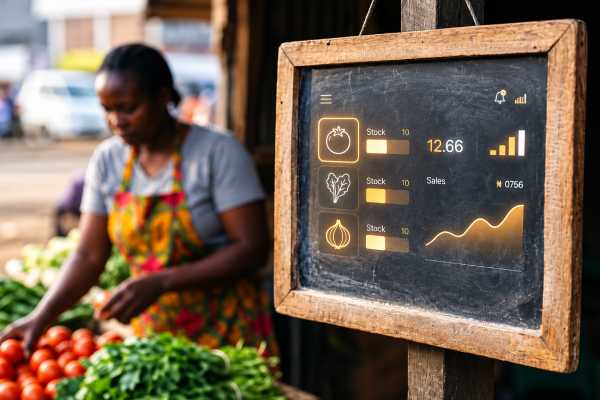
There is a mama mboga near my place who has never raised a shilling of venture capital. She has no app, no board and no pitch deck. She has been in business for years, and she will be there tomorrow morning.
Last month, a Kenyan High Court ordered Copia Kenya into liquidation. Copia was built to serve the same kind of customer she serves: ordinary Kenyans buying everyday goods in small amounts. At its peak it had about 1,800 staff and more than 50,000 agents, and it raised tens of millions of dollars from serious investors. After more than two years in administration, the court found the rescue had run its course.
So here is the question I keep coming back to. Everyone says the informal sector is where the opportunity is in Kenya. If that’s true, why does it keep breaking companies with far more money and talent than that mama mboga?
I’ve spent some time digging into this. The answer is more useful than “the informal sector is big” or “the informal sector is risky”. It’s about how you serve it.
The informal economy is the real economy
Let’s start with the numbers, because they are striking. According to the KNBS Economic Survey 2026, the informal sector makes up about 84% of all employment in Kenya. It accounted for close to nine in every ten new jobs created in 2025. Formal wage employment, by comparison, sits at around 3.3 million jobs.
Think about what that means for a business. If you only build for formal companies and salaried workers, you are fighting over a small slice of the country. The jua kali artisan, the boda rider, the salon owner, the duka, and the mama mboga are most of the market.
There’s a famous idea behind this. In 2004, C.K. Prahalad wrote The Fortune at the Bottom of the Pyramid. His argument was simple: poor customers spend small amounts individually, but there are so many of them that the total is enormous, and big companies mostly ignore them.
Kenya has the world’s most famous proof. Before M-Pesa launched in 2006, about a quarter of Kenyans had access to banking products. By 2014, that was roughly two-thirds. Equity Bank grew the same way, by serving ordinary Kenyans the big banks didn’t want.
So far, the idea holds. Big market, badly served, less competition. Why, then, the graveyard?
The trap: big market, thin margins
Copia isn’t alone. Between 2022 and 2024, several well-funded platforms tried to serve Kenya’s informal retailers and either collapsed or shrank sharply.
- MarketForce (RejaReja) served about 270,000 informal merchants at its peak, then shut down its B2B arm in 2024. Its co-founder said the segment was so price-sensitive that the price wars never stopped.
- Twiga Foods raised over $100 million and has since cut back significantly from its peak.
- Even M-Pesa, the great success story, failed in South Africa. After six years, it withdrew in 2016 with only around a million registered users.
In 2007, the economist Aneel Karnani wrote a sharp reply to Prahalad called The Mirage at the Bottom of the Pyramid. His warning was that low-income customers have very little spare money, switch for small price differences, and are expensive to reach. Many of these failures look exactly like his warning.
When I looked closer, the same problems kept showing up:
- Thin margins. Moving soap, flour, and cooking oil earns a few percent at best.
- Heavy operations. Trucks, warehouses, fuel, and staff cost the same whether the order is big or small.
- Credit risk. Many platforms gave Dukas stock on credit. Collecting it, with no contracts or records, was brutal.
- No loyalty. A trader will switch suppliers for one shilling. That means constant price wars.
- Impatient money. Investors wanted fast growth in a market that rewards slow trust-building.
Notice something: the informal sector didn’t fail these companies. Their models did.
What the winners did differently
Put the winners next to the losers, and a clear pattern appears.
- They were formal businesses serving informal people. Safaricom and Equity are fully compliant, listed companies. The opportunity was never to be informal. It was to serve the informal sector, with structure on your side.
- They sold something light, not something heavy. M-Pesa moves data, not goods. Each extra transaction costs almost nothing to process. Copia and others moved boxes on trucks.
- They charged small amounts, often. A small fee per transaction fits how informal businesses earn: daily, in small amounts. A big upfront fee or a monthly subscription doesn’t.
- They used networks that already existed. M-Pesa didn’t build shops. It paid existing airtime kiosks a commission to become agents.
- They were patient. By Safaricom’s own account, M-Pesa took about three years to start making money.
There’s one more lesson, and it’s the one I think matters most. Informal businesses don’t buy “structure”. They buy results.
Nobody signed up for M-Pesa because they wanted transaction records. They signed up to send money home. The records came for free, and years later, those records made mobile loans like M-Shwari possible.
That’s the playbook: hide the structure inside something people already want.
Where digital tools fit (and where they don’t)
This is where my day job comes in. At Digital4Africa, we build websites, run SEO, train teams, and set up AI automation and ERP systems. I’ve learned that the tools only work when they follow the playbook above.
Here’s what that looks like in practice.
If you’re a business selling to informal customers, such as a distributor supplying dukas, a wholesaler, or a service business, your challenge is keeping your cost per customer low. You can’t afford a sales rep visiting every kiosk. But a WhatsApp ordering assistant that takes orders, answers questions, and confirms M-Pesa payments can serve hundreds of small customers a day. That’s the M-Pesa lesson: let software carry the volume.
If you’re an informal business that’s growing, there’s a moment when the exercise book stops working. Maybe it’s stock going missing, customers on credit you can’t track, or a supplier or bank asking for records you don’t have. This is where an ERP comes in. We build on ERPNext, an open-source system that brings stock, sales, purchases, credit, and accounts into one place. It can also be set up to support KRA requirements like eTIMS invoicing, which is pushing many small businesses toward proper records anyway.
The important part is how you introduce it. Don’t sell “bookkeeping” to a trader. Sell what they feel every day:
- “Know exactly what’s in stock before you reorder.”
- “See who owes you money, and remind them automatically.”
- “Get your records in shape so a bank will lend to you.”
The structure comes along with the result. That’s how you bring a business from informal to formal without making it feel like a burden.
And for founders building for this market: be formal yourself. Register, stay compliant, keep clean books. Then build something light and digital that informal customers pay for in small amounts. Every winner in this story was a structured business serving an unstructured market.
So, is the informal sector the better bet?
My honest answer: the informal sector is bigger, but it’s only more profitable if your model is built for it. Formal clients give you margin. Informal customers give you scale. The businesses that last either combine the two or run a structured operation that serves informal customers cheaply, digitally, and in small amounts.
The mama mboga near my place already understands this better than many funded startups. She keeps her costs tiny, serves people she knows, and gets paid daily. The rest of us just need tools that let us do the same thing at scale.
If you’re running your business on an exercise book, a spreadsheet only one person understands, or a POS that can’t tell you what’s actually selling, you’ve hit the same ceiling. Your business has outgrown the way it keeps track of itself. At Digital4Africa, we help businesses move to systems that fit how they really work, from WhatsApp ordering to a full ERP built.
The market is already here, and it’s the biggest one in Kenya. The only question is whether your systems are ready to serve it. Talk to us at Digital4Africa, and let’s build the business your customers already think you are.
So should Kenyan businesses formalise first and then grow, or meet the informal market where it is and formalise along the way?