Domain Name Registration in Kenya and Across Africa

Register your .com, .co.ke, .africa or country domain in your own name. We help you choose it, buy it and keep it safe.

Your domain is the one part of your online presence you should never leave in someone else’s hands. Websites get rebuilt, hosts change and developers move on. The name stays with you.

Digital 4 Africa helps businesses, NGOs and startups in Kenya, Uganda, Tanzania, Rwanda, Burundi, Ethiopia, Nigeria, Ghana, South Africa and South Sudan choose the right domain name, register it with the right registrar and connect it to their website and email.

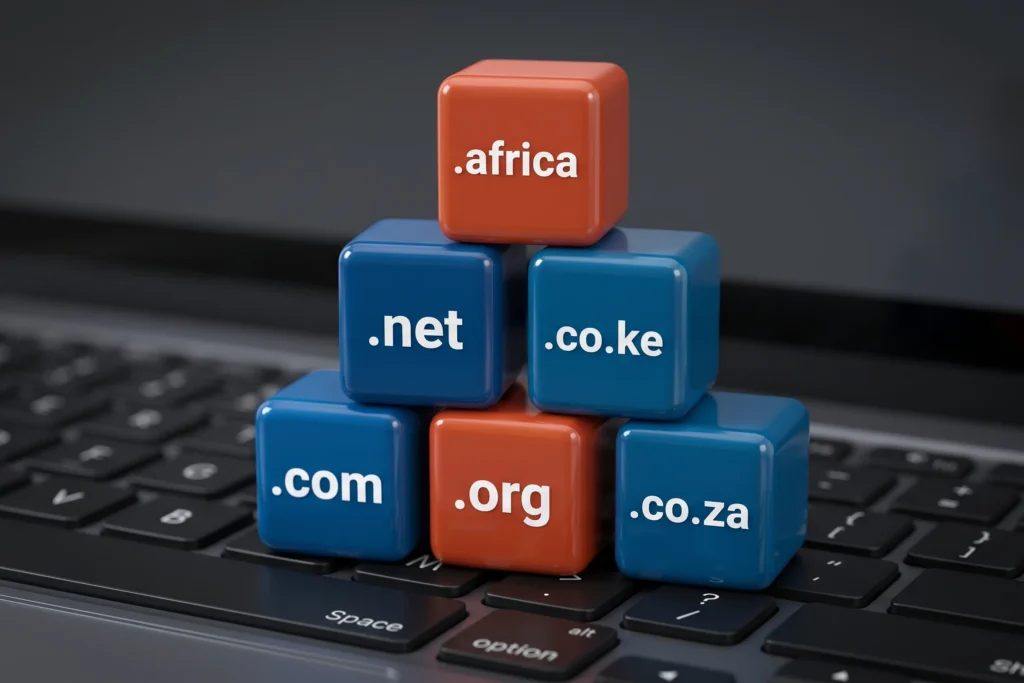
We cover global endings such as .com, the pan-African .africa and country endings such as .co.ke, .co.ug, .co.tz, .rw, .com.ng, .com.gh and .co.za. We show you the renewal price, not just the first-year offer, and the domain is always registered to you.
Domain Registration In Kenya (1)
Domain Name Registration in Kenya and Across Africa

Trusted by businesses across Africa. Built for the way business works here.

What Is a Domain Name?

Your address online, and the key to your website and business email

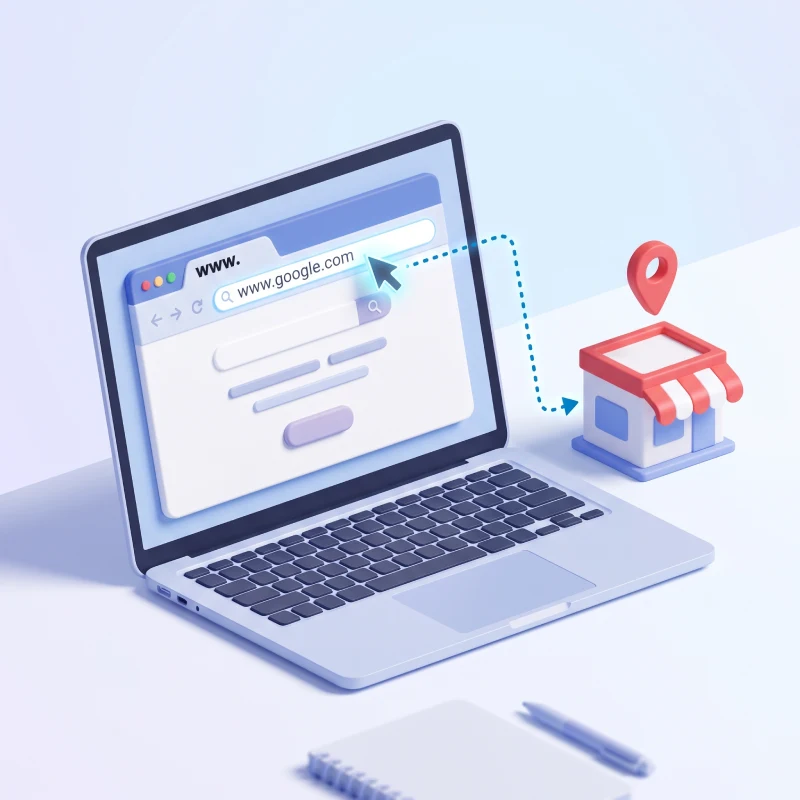
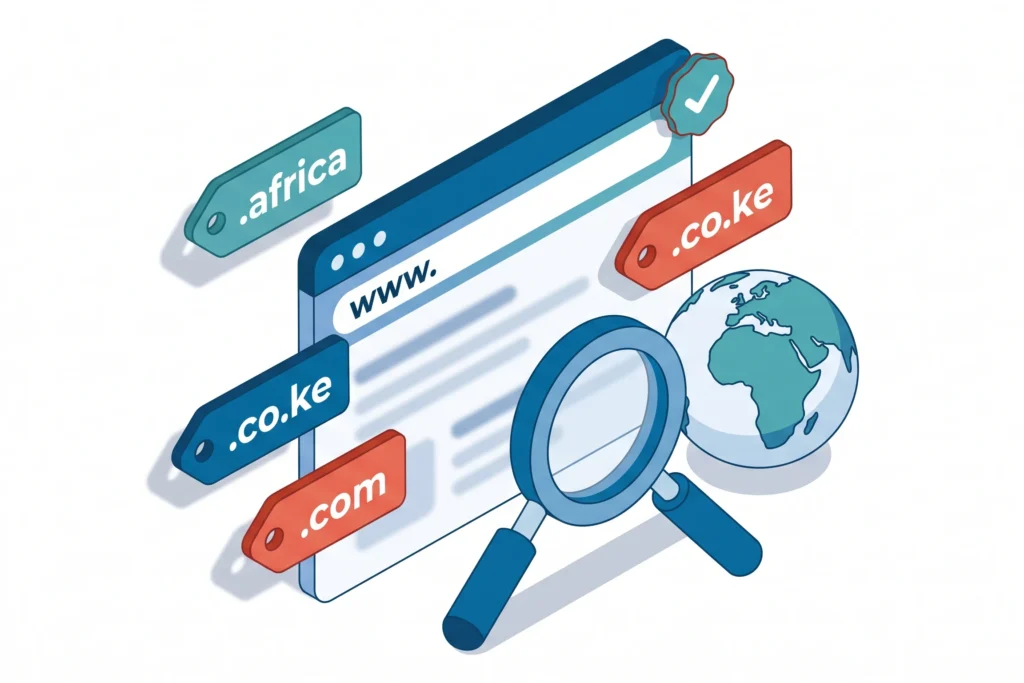
A domain name is the address people type to find you, such as yourbusiness.co.ke or yourbusiness.africa. It also carries your business email, so [email protected] only works while the domain is active and renewed.

Four parties are involved. A registry runs each ending, such as KeNIC for .ke or ZACR for .co.za and .africa. Accredited registrars sell names under that ending to the public. You, the registrant, hold the name for as long as you keep renewing it. Your DNS settings then tell the internet where your website and email live.

You never buy a domain outright. You register it for a set term, usually one to ten years depending on the ending, and renew it before it expires.

Wha is a domain Name

Choose Your Domain

Pick the name first, then the ending. A few minutes of checks now saves a rebrand later.

How to Choose a Domain Name

Short, easy to say and registered in your name

A good domain name is short, easy to spell and matches the name your customers already use for you. It ends up on your invoices, vehicles, packaging and email signatures, so changing it later is costly.

Start with the name, then choose the ending. A global ending such as .com suits brands selling across borders. A country ending such as .co.ke, .com.ng or .co.za tells local customers you are based where they are. Many businesses register both and point one to the other.

Check the renewal price, not just the first-year price. Introductory offers often renew higher.

One rule we never break. The domain is registered in your name or your company’s name. Not ours, and not your developer’s.

Use these tips when buying a domain name

The shorter the name the better
Search the name on Google before committing to buy the domain
Say it out loud before you buy it. If you have to spell it for someone, pick another name
Skip hyphens and numbers. People forget them, and they are awkward to read out
Check the trademark registers too, not just Google. A live trademark can cost you the name later
Compare the renewal price, not the first year offer. Cheap promos often renew at several times the price
Register the domain in your own name and your own account. Never let a developer or agency hold it for you

Which Domain Ending Should You Choose?

.com, a country domain or .africa? It depends on where your customers are.

The ending, or top-level domain, is the part after the dot. It affects who trusts your address, how search engines treat it and what you pay each year. Here is how the main options compare. Last checked: September 2026.

Our default advice

If you serve one country, make that country’s ending your main address and register the .com as well to protect the name. If you sell across borders, lead with .com. If you operate in several African countries, consider .africa alongside your .com.

Ending Best for Watch out for
.com Brands selling across borders, exporters and tech startups. It is the ending most people type by default. Most short names are taken. You compete with the whole world for the name you want.
Country endings
.co.ke, .co.ug, .co.tz, .rw, .com.ng, .com.gh, .co.za Businesses serving one country. It signals that you are local and helps search engines match you to searches in that country. Each registry sets its own rules. Some need local documents, and many global registrars do not sell them.
.africa Organisations working across several African countries, regional brands and pan-African campaigns. Less familiar to some users than .com. Confirm your registrar sells it before you plan around it.
Non-profit endings
.org, .or.ke, .or.tz, .org.za NGOs, foundations, associations and community groups. Country versions may ask for proof that you are a registered non-profit.
Newer endings
.store, .tech, .online Product launches, campaigns and names where the .com is taken. Renewals can cost several times the first-year price, and some customers trust them less.

Domain Registration Services

Registration, transfers, renewals and recovery

Global and Pan-African Domains

.com, .net, .org, the pan-African .africa and newer endings such as .online or .store. Some hosting plans include one free for the first year.

Country Domains

.co.ke, .co.ug, .co.tz, .rw, .com.ng, .com.gh, .co.za and .ss. Each country’s registry sets the rules, and you buy through an accredited registrar.

Non-Profit, Academic and Government Domains

.or.ke, .or.tz and .org.za suit non-profits. In Kenya, .ac.ke, .sc.ke and .go.ke need supporting documents before they go live. We prepare the paperwork with you.

Transfers, Renewals and Recovery

Move a domain to a better registrar, recover a lapsed renewal or one held by a former developer, and stop losing your name to a missed invoice.

Where to Buy a Domain

Your registrar decides your renewal price, your dashboard and who you call when something breaks

cloudflare logo

Buying Domains with Cloudflare

Cloudflare is our top recommendation for buying global domains such as .com. The dashboard is simple, and everything sits in one place: DNS, redirects, renewals and transfers. You get free SSL, DDoS protection and DNS security as standard, so your site is protected from day one. The free tier covers most small sites, and domains are sold at cost with no markup, so the renewal price matches the first-year price.

One caveat. Cloudflare does not support every extension. African endings such as .africa, .co.ke and .co.tz are not on its list, so you will need a different registrar for those.

CLOUDFLARE
Hostinger Logo

Buying Domains with Hostinger

Hostinger is our second pick, and a good one if you want hosting and a domain in one place. The hPanel dashboard is easy to learn, so beginners are not left guessing. You get free WHOIS privacy, and some annual plans include a free domain for the first year. Support is available round the clock, which helps when something breaks at an odd hour.

One caveat. The low prices apply to the first term only. Renewals cost more, so check the renewal rate before you commit. Cloudflare remains our first choice for global endings.

Hostinger

Other Domain Providers

Beyond those two, the field is crowded but manageable. Namecheap and Porkbun are the usual favourites for fair renewal pricing and clean dashboards. Dynadot and Name.com sit in the same bracket. GoDaddy has the widest reach and the biggest catalogue, though you pay for the upsells and the renewals. In Europe, Gandi, OVHcloud and IONOS are solid, and Squarespace now holds what used to be Google Domains. For unusual extensions, 101domain and Netim cover ground the big names skip.

Across Africa, look to Afrihost and Xneelo in South Africa, Whogohost in Nigeria, HOSTAFRICA across the region, and Truehost in several markets. The pattern is the same everywhere. Local country extensions are usually sold through registrars accredited by that country’s registry, so you may need a local provider for the domain even when your hosting sits elsewhere. The same goes for .africa, which not every registrar sells. Compare renewal prices, transfer rules and privacy terms before you pick.

Namecheap Logo
Porkbun Logo
GoDaddy Logo
Afrihost Logo
True Host Logo

Buying Local Domains

We are based in Nairobi and work with clients across East, West and Southern Africa. Every country runs its own domain registry and rules. Checking availability calls for the right tool. Most international search tools will report a local domain as unavailable or unsupported when it is actually free to register, so check with the country registry or an accredited local registrar instead. Here is what you need to know in each market we serve. Last checked: September 2026.

Domains and Hosting in Kenya

Popular domains: .co.ke and .ke. Non-profits use .or.ke. Academic, school and government endings (.ac.ke, .sc.ke and .go.ke) need supporting documents.

Who can register: KeNIC, the national registry, says any company or individual can register a .ke domain through an accredited registrar.

Paying: most Kenyans expect to pay by M-Pesa. Global hosts usually bill in US dollars by card.

How we help: we point you to an accredited registrar, check the domain is in your name, connect it to the hosting that fits and support you from Nairobi.

Domains and Hosting in Uganda

Popular domains: .ug and .co.ug, with .or.ug for organisations.

Who can register: registrars list no local presence requirement. Prices vary widely between registrars, so compare before you buy.

Paying: mobile money is widely used. Check whether your host accepts it, or plan for card payments.

How we help: we point you to an accredited registrar, guide the purchase, set up hosting and email, and support you remotely.

Domains and Hosting in Tanzania

Popular domains: .co.tz and .tz, with .or.tz for NGOs and .ac.tz for academic institutions.

Who can register: .tz has been open to direct registration since 2022, with no local presence requirement. Confirm the current .co.tz rules with an accredited registrar before you apply.

Paying: tzNIC lists a registration fee of TZS 25,000 through its accredited registrars, and some accept M-Pesa and Mixx by Yas (formerly Tigo Pesa).

How we help: we help you choose the right ending, guide the registration in your name and set up hosting and email around it.

Domains and Hosting in Ethiopia

Popular domains: .com.et for businesses, .org.et for non-profits and .edu.et for educational institutions.

Who can register: Ethio Telecom, the state telecoms provider, runs the .et registry. Registration is generally limited to entities based in or connected to Ethiopia, and the process runs through the operator rather than a wide network of registrars.

Paying: paying international hosts in foreign currency can be difficult in Ethiopia. We plan around that rather than pretend it is not an issue.

How we help: we advise on whether .com.et is realistic for your situation, set up hosting and business email that you can actually pay for, and support you remotely.

Domains and Hosting in Rwanda

Popular domains: .rw and .co.rw. Non-profits use .org.rw. Academic and government endings (.ac.rw and .gov.rw) need authorisation from the relevant ministry or board.

Who can register: RICTA, the national registry, says any individual or organisation can register a .rw domain, with no residency or citizenship requirement. Some second-level endings have their own rules.

Paying: mobile money is the norm in Rwanda. Global hosts usually bill in US dollars by card.

How we help: we guide you through registering with an accredited registrar, connect the domain to the hosting that fits and support you remotely from Nairobi.

Domains and Hosting in Burundi

Popular domains: .bi and .co.bi.

Who can register: NIC Burundi, part of the Centre National de l’Informatique, manages .bi and registers through accredited registrars. The registry expects a connection to Burundi, and asks that the name reflects your actual business or brand.

Paying: .bi is priced well above most country domains, often over USD 100 a year. Budget for that before you choose it.

How we help: we advise on whether .bi or a global ending serves you better, guide you through registering with an accredited registrar, and set up hosting and email around it.

Domains and Hosting in Nigeria

Popular domains: .com.ng and .ng.

Who can register: .com.ng is open to anyone. You do not need to be a Nigerian citizen or company.

Paying: Hostinger’s Nigeria site bills in naira and accepts Visa, Mastercard and OPay. Local hosts also bill in naira.

How we help: we recommend naira-billed hosting where it fits, guide you through registering your domain in your name and set up business email.

Domains and Hosting in Ghana

Popular domains: .com.gh for businesses, .org.gh for non-profits and .edu.gh for educational institutions.

Who can register: .com.gh is restricted. Registrars require a business registered in Ghana and a local administrative contact, with company documents submitted as proof. Registration is managed through registrars accredited by the Ghana Domain Name Registry.

Paying: mobile money is widely used in Ghana. Global hosts usually bill in US dollars by card.

How we help: if you have a Ghanaian entity, we help you prepare the paperwork and guide the registration. If you do not, we will tell you honestly and recommend a global ending instead.

Domains and Hosting in South Africa

Popular domains: .co.za, with .org.za for non-profits. .za is Africa’s largest country domain.

Who can register: .co.za is open to anyone, anywhere in the world.

Servers: local hosts run servers in South Africa. AWS has a Cape Town region, and Microsoft runs Azure data centres in the country.

How we help: we compare local and global hosts, guide you through registering your .co.za and set up hosting, email and support.

Domains and Hosting in South Sudan

Popular domains: .ss, which opened to direct registration, such as yourname.ss, in late 2024.

Who can register: the registry says you do not need a trade licence or a local base to buy a .ss domain.

Registry: ssNIC, part of the National Communication Authority. Registration runs through accredited registrars.

How we help: .ss is a young, small registry. We guide you through registration and set up dependable hosting and email around it.

The Pan-African .africa Domain

Popular use: regional brands, pan-African NGOs and campaigns that span several countries.

Registry: Registry Africa, a subsidiary of ZA Central Registry (ZACR), which also runs .co.za. Registration runs through accredited registrars.

Who can register: the registry says no local presence or documents are required, so individuals and businesses anywhere can register.

How we help: we check whether your registrar sells .africa, guide the purchase in your name and set it up alongside your .com or country domain.

Outside these countries? We work remotely with clients across the continent. Tell us where you are and what you need.

Protect Your Domain From Lapses and Lockouts

Most lost domains are not stolen. They are forgotten, or held by the wrong person.

Businesses usually lose a domain in one of three ways. The renewal notice goes to a former employee’s inbox. The card on file expires. Or a developer registered the name in their own account and moved on. Each one is easy to prevent.

Turn on auto-renew, and keep a payment method that will still work at renewal
Use a registrar contact email that does not sit on the same domain, so reminders still arrive if it lapses
Protect the registrar account with two-factor authentication
Keep the registrar lock on unless you are moving the domain
Renew your main domain for several years at a time
Register close variants and your country ending so nobody else can
Turn on DNSSEC where your registrar supports it

Domain Held by Someone Else?

If a former developer, agency or staff member controls your domain, you are not alone. It is a common problem, and usually fixable. We check who is listed as the registrant, gather the proof you need and help you move the domain into an account you control, with your website and email kept running during the move.

Renewal Management

Prefer not to think about renewals at all? We track the dates and send reminders, so every domain and hosting plan you own renews on time.

Buying a domain for vibe-coded websites

The tool you build with will change. Your domain should not.

AI tools let you build a website in an afternoon, but each one handles your domain differently. Lovable publishes to a free lovable.app address and only connects your own domain on a paid plan, though you can sync the code to GitHub and host it yourself instead. Bolt publishes to its own hosting or to Netlify, where you add your domain in the domain settings. Google AI Studio is free to use, publishes to Google Cloud Run, lets you deploy two apps without a credit card and gives each one a free ai.studio subdomain, though pointing your own domain at it means mapping it in Cloud Run.

For a simple one-page site, you can skip builders entirely: ask Claude or ChatGPT for a complete HTML file, upload it to hosting you already pay for, and point your domain at it. Whichever route you take, register the domain in your own name, keep the DNS where you can reach it, budget for the monthly subscription as well as the build, and remember that no builder gives you business email. That still needs your hosting, Google Workspace or Microsoft 365. Built something already? We will get it onto your own domain, with email working and search engines able to read it.

Buying a domain for vibe coded website
The tool you build with will change. Your domain should not

Free Tools for Domains and DNS

Check a domain, test your DNS or scan your site in seconds

Domain lookup and ownership

ICANN Lookup – Official registration data for .com and other global domains.
Who.is – WHOIS lookups with history, covering many country domains.
ViewDNS.info – Reverse IP lookup, WHOIS, port scan and DNS tools in one place.
DomainTools WHOIS – WHOIS with ownership history and hosting records.

DNS checks and propagation

whatsmydns.net – See whether a DNS change has spread to servers around the world.
DNSChecker.org – Propagation checks plus record lookups and DNS health reports.
Google Admin Toolbox Dig – Read any DNS record exactly as Google’s resolvers see it.
DNSViz – Visualise a domain’s DNS and DNSSEC setup and spot broken links.
IntoDNS – A quick health report on nameservers, MX records and common misconfigurations.

Email and deliverability

MXToolbox – Check MX, SPF and blacklist status when your email lands in spam.
Mail-Tester – Send a test message and see why it might be flagged as spam.
DMARC Analyzer Inspector – Check whether your SPF, DKIM and DMARC records are set correctly.
Google Postmaster Tools – See how Gmail treats mail from your domain.

Security and certificates

SSL Labs Server Test – Confirm your SSL certificate is installed and configured correctly.
crt.sh – Find every SSL certificate ever issued for your domain.
Sucuri SiteCheck – Scan a site for malware and blacklist warnings.
Google Safe Browsing Status – Check whether Google has flagged your site as unsafe.
Have I Been Pwned Domain Search – See whether email addresses on your domain appear in known breaches.

Speed and uptime

PageSpeed Insights – Test how fast your website loads on mobile and desktop.
GTmetrix – Speed tests you can run from a chosen country.
WebPageTest – Detailed load testing with waterfall charts.
UptimeRobot – Free alerts when your site or server goes down.

Hosting and technology research

Netcraft Site Report – See who hosts a site, where, and what it runs on.
BuiltWith – Identify the technology stack behind any website.
SecurityTrails – Historical DNS and WHOIS records, useful for tracing past setups.
Shodan – See what services a server exposes to the internet.

Choosing and pricing a domain

Instant Domain Search – Availability results as you type.
TLD-List – Compare registrar prices for registration, renewal and transfer.
NameBeta – Price comparison across registrars, including renewals.
ExpiredDomains.net – Browse dropped domains that already have history.
ICANN Registrar Directory – Verify a registrar is genuinely accredited.

Search and indexing

Google Search Console – See how Google crawls and ranks your domain.
Bing Webmaster Tools – The same for Bing, which also feeds some AI assistants.
Wayback Machine – See what a domain looked like in the past.

Terminal commands (no URL, run on your own machine)

whois – whois example.com – Registration and expiry details straight from the registry.
dig – dig example.com ANY – Query any DNS record without a browser.
nslookup – nslookup example.com – The simpler DNS lookup, available on Windows by default.
host – host example.com – A quick one-line answer for A, MX and NS records.
curl -I – curl -I https://example.com – See response headers, redirects and server details.
openssl s_client – openssl s_client -connect example.com:443 – Inspect an SSL certificate from the command line.
ping and traceroute – traceroute example.com – Check reachability and the route traffic takes.

Country domain registries

KeNIC (Kenya) – Kenya’s .ke registry, with its list of accredited registrars.

.UG Registry (Uganda) – Uganda’s .ug registry, run by Uganda Online.

tzNIC (Tanzania) – Tanzania’s .tz registry, operating under the TCRA.

Karibu.tz (Tanzania) – tzNIC’s official .tz registration portal, with its list of accredited registrars.

Ethio Telecom (Ethiopia) – The state operator that runs .et domain registrations.

RICTA (Rwanda) – Rwanda’s .rw registry, with policies and accredited registrars.

NIC Burundi – Burundi’s .bi registry, with its registrar directory.

NiRA (Nigeria) – Nigeria’s .ng registry, with accredited registrars.

GhNIC (Ghana) – Ghana’s .gh registry, with registrars, policies and WHOIS.

ZACR (South Africa) – Runs .co.za, .org.za, .net.za and .web.za registrations.

ZADNA (South Africa) – The regulator overseeing South Africa’s .za namespace.

ssNIC (South Sudan) – South Sudan’s .ss registry, under the National Communication Authority.

.africa Registry (ZACR) – The pan-African .africa registry, with its list of accredited registrars.

IANA Root Zone Database – The official registry contact for every domain ending worldwide.

How It Works

Four steps from a name idea to a domain that works and stays yours

1. Choose

Tell us the name you want, where your customers are and how you pay. We check availability across the endings that fit.

2. Register

You buy directly from the registrar, in your name. For country endings that need documents or a local registrar, we handle the paperwork with you.

3. Connect

We set the DNS records so your website, SSL certificate and business email work, then test each one.

4. Protect

We turn on auto-renew, the registrar lock and reminders. Stay on renewal management, or call us when you need a hand.

FAQs About Domain Registration in Kenya and Africa

Straight answers on choosing, registering, paying for and protecting your domain

Choose your name, check that it is free with a KeNIC-accredited registrar, then pay for at least one year with you or your company listed as the registrant. Most .co.ke and .ke registrations go live the same day. Academic, school and government endings such as .ac.ke, .sc.ke and .go.ke need supporting documents before they are approved.

At the time of writing, a .co.ke domain costs roughly KES 1,000 to KES 1,500 a year at many Kenyan registrars, depending on the registrar and any offers. Check the renewal price as well as the first-year price, and make sure the domain is registered in your name.

Yes. KeNIC, Kenya’s domain registry, says any company or individual can register a .ke domain through an accredited registrar. Academic, school and government endings such as .ac.ke, .sc.ke and .go.ke need supporting documents. Non-profits should use .or.ke.

Choose a country domain if most of your customers are in one country. It tells them you are local and helps search engines show you in that country. Choose .com if you sell across borders. Many businesses register both, use one as the main address and redirect the other, which also stops anyone else taking the name.

.africa is a pan-African ending launched in 2017 and run by Registry Africa, a subsidiary of ZA Central Registry (ZACR), the registry behind .co.za. It suits organisations working across several African countries. The registry requires no local presence and no documents, so anyone can register one. Many international registrars sell it, though Cloudflare does not at the time of writing.

We help with domains in Kenya, Uganda, Tanzania, Rwanda, Burundi, Ethiopia, Nigeria, Ghana, South Africa and South Sudan, plus .africa and global endings. Some are open to anyone, such as .co.ke, .com.ng and .co.za. Others are restricted. .com.gh needs a business registered in Ghana, and .et registration is generally limited to entities connected to Ethiopia. We tell you upfront which ones you qualify for.

Often, yes, through local registrars. Many Kenyan registrars accept M-Pesa, and local registrars in Uganda, Tanzania, Rwanda and Ghana commonly accept mobile money. Global registrars such as Cloudflare and Hostinger usually bill in US dollars by card or PayPal, while Hostinger’s Nigeria site bills in naira. Pick a payment method you can use at every renewal, not just the first.

Unlock the domain at your current registrar, request the transfer code, also called an EPP or authorisation code, and start the transfer at the new registrar. For .com and most global endings, the move usually completes within a week and adds a year to your registration. New and recently transferred domains are locked from moving for a period. That lock is commonly 60 days today, and ICANN’s policy process has recommended cutting it to 30 days. Country endings follow their own registry’s rules.

Your website and business email stop working, often within days. Most global endings then enter a grace period where you can still renew at the normal price, followed by a redemption period of around 30 days where recovery costs extra. After that, the name is released and anyone can register it. Country endings set their own timelines, so turn on auto-renew and keep your contact details current.

Ask them to change the registrant to you or your company and hand over the registrar login, or to give you the transfer code so you can move the domain into your own account. If they will not cooperate, you may be able to resolve it through the registrar or the registry’s dispute process, using invoices, company documents or trademark records as proof. We can guide you through each step and handle the technical work.

WHOIS privacy hides your personal contact details from public domain lookups, which cuts spam, scam calls and fake renewal notices. Many registrars include it free for global endings. Some country endings do not offer it or already limit what is shown. Privacy never changes who legally holds the domain.

Not to own it, but you do to run a website or business email on it. The domain is the address, hosting stores the website, and email needs a mail service such as your hosting plan, Google Workspace, Microsoft 365 or Zoho Mail. You can buy each from a different provider and connect them with DNS records.

You do. You buy the domain directly from the registrar, in your name or your company’s name, and the account and login stay with you. We guide the purchase and handle the setup, but we never hold your domain. If you ever move to another provider or partner, the domain goes with you.

Let's Secure Your Domain, Properly

Tell us the name you want and where your customers are. We will recommend the ending and the registrar that fit.

Most domain problems start on day one. A name registered in someone else’s account, an ending you cannot easily renew from your country, or a renewal notice that goes to an inbox nobody reads.

We work the other way round. We start with where your customers are, how you pay and what you plan to build. Then we point you to the right registrar, make sure the domain is in your name and connect it to your website and email.

Book a free consultation with Digital 4 Africa. No jargon and no obligation. Just a clear recommendation you can act on.

securing a domain Digital4africa

Share This Page