ERP Systems in Kenya for Growing Businesses

ERPNext, Odoo and Microsoft Dynamics 365 implementation, integration and support.

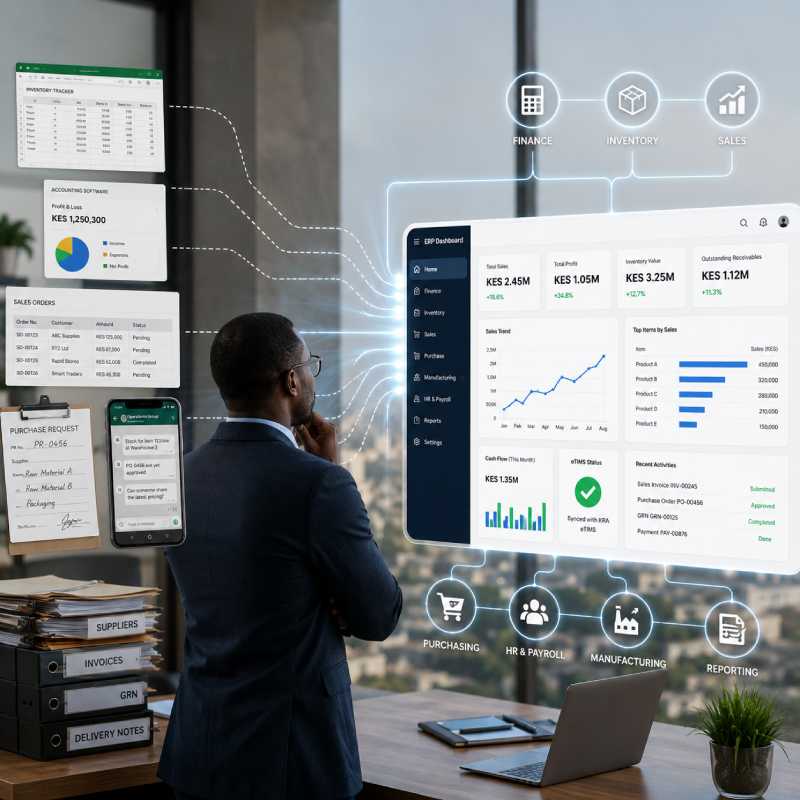
Your business should not need five spreadsheets, three disconnected systems and a WhatsApp group to understand what is happening.

Digital 4 Africa helps growing businesses in Kenya select, set up, customise, integrate and support ERP systems that bring finance, inventory, purchasing, sales, manufacturing, projects, HR and other core operations into one connected system.

We lead with ERPNext because it offers a powerful open-source ERP foundation with no per-user licence fee, but we also work with Odoo, Microsoft Dynamics 365, Sage, SAP Business One and Zoho where they make better business sense.

ERP CRM Solutions for Modern African Businesses

Trusted by businesses across Africa. Built for the way business works here.

What Is an ERP System?

An ERP, or Enterprise Resource Planning system, is software that connects the core operations of a business through a shared system and database.

Instead of keeping accounting, inventory, purchasing, sales, manufacturing, projects, HR and other business information in separate applications, an ERP allows those functions to work from connected records.

A sale can update inventory. Inventory movements can affect accounting. A purchase can update supplier balances. A production order can consume raw materials. Management can see the resulting information without waiting for someone to reconcile several spreadsheets.

The goal of ERP software is simple: give the business one reliable operational system and better visibility over how work, money, stock and resources move through the organisation.

Why Businesses Need ERP Software

Busy Everywhere, Certain Nowhere

If your finance team closes the month late, your stock numbers require a physical count, purchasing is handled through email and WhatsApp, or management cannot get reliable figures without asking several people, the problem may not be your people.

It may be your systems.

An ERP brings those processes together so that information is captured once and becomes useful across the business.

When Is It Time to Implement an ERP?

An ERP becomes increasingly valuable when:

Your business has outgrown spreadsheets
Finance, inventory and sales use different systems
Stock accuracy is becoming difficult to maintain
Management needs real-time reporting
Staff repeatedly enter the same information into different systems
You are growing into manufacturing, distribution or more complex operations
Your business needs better purchasing and supplier control
You need your invoicing system connected to KRA eTIMS
You want to automate repetitive processes instead of adding more administrative work
ERP CRM Solutions for Modern African Businesses

ERP Software for Kenya

Global ERP software needs local implementation

Choosing an ERP is not only about comparing software features.

A system has to fit the way your business operates, the skills of your team, your reporting requirements, your industry, your existing technology and the regulatory environment in which you operate.

For businesses in Kenya, that can include KRA eTIMS, Kenyan payroll requirements, M-Pesa and other payment integrations, local banking, VAT processes, multi-currency transactions and the realities of operating across East Africa.

We configure the ERP around your business rather than asking your business to conform blindly to a generic installation.

KRA eTIMS Integration

Connect your ERP and invoicing workflows to eTIMS through the appropriate system-to-system integration route.

M-Pesa & Payment Integration

Connect collections, payment confirmations and reconciliation to the ERP instead of relying on manual matching.

Finance & Tax Workflows

Build accounting, invoicing, purchasing, tax and reporting processes around the way your Kenyan business actually operates.

Our ERP Services

From ERP selection to implementation, integration and long-term support

1. ERP Consulting & Selection

We assess your processes, systems, data and goals before recommending an ERP platform.

Business Process Discovery

We map how finance, sales, purchasing, inventory, production and management actually work.

ERP Platform Selection

Compare ERPNext, Odoo, Dynamics 365, Sage, SAP Business One and Zoho against your requirements.

Implementation Planning

Define scope, modules, data, integrations, users, milestones and go-live requirements.

2. ERP Setup & Implementation

We install, configure and prepare the ERP for real operational use.

Installation & Hosting

Self-hosted or cloud ERP deployment, with security, backups and appropriate infrastructure.

Module Configuration

Accounting, inventory, purchasing, selling, manufacturing, projects, HR and payroll configured for your business.

Customisation

Custom fields, workflows, print formats, permissions, dashboards and reports where standard configuration is not enough.

3. ERP Integration

An ERP creates more value when it can exchange information with the systems around it.

System Integration

Connect websites, e-commerce, payment platforms, banks, payroll, warehouse systems and other business applications.

API Integration

Design API-based connections and data flows between your ERP and other systems.

Workflow Automation

Use automation platforms such as n8n to move information and trigger business processes without repetitive manual work.

4. Data Migration & Training

A new ERP is only useful when your data and people are ready to use it.

Data Migration

Move customers, suppliers, products, stock, opening balances and other records from spreadsheets and legacy systems.

Data Cleaning

Identify duplicates, incomplete records and inconsistent data before importing it into the ERP.

Team Training

Role-based training for finance, operations, stores, sales, management and other ERP users.

5. ERP Support & Maintenance

Go-live is the beginning of the ERP relationship, not the end of it.

Ongoing Support

Get help with issues, configuration changes, reports, workflows and day-to-day ERP questions.

Updates & Maintenance

Keep the ERP environment maintained and plan upgrades rather than allowing the system to become outdated.

Security & Backups

Protect the ERP environment with appropriate access controls, backups, monitoring and maintenance.

6. AI & ERP Automation

Modern ERP is increasingly about automation, intelligence and better decisions, not just record keeping.

AI Assistants & Agents

Explore practical AI workflows that can work with ERP data and assist with repetitive operational tasks.

Forecasting & Analytics

Use ERP data for reporting, forecasting, planning and management decision-making.

Intelligent Automation

Automate reconciliation, reporting, document processing, alerts, approvals and other repetitive processes.

What Can an ERP Manage?

One platform can connect many parts of the business

ERP CRM Solutions for Modern African Businesses

ERP for Kenyan Businesses

eTIMS, Payments & Local Integration. Make the ERP fit the environment in which your business operates

An ERP implementation in Kenya needs to consider more than the software itself.

Businesses may need to connect their ERP with KRA eTIMS, M-Pesa, banks, payment gateways, websites, e-commerce platforms, payroll systems and other applications.

KRA provides system-to-system eTIMS integration through OSCU and VSCU for appropriate business and invoicing scenarios. We help businesses design the ERP and integration architecture around those requirements rather than treating compliance as an afterthought.

KRA eTIMS

ERP and invoicing workflows designed around the appropriate eTIMS integration approach.

M-Pesa & Daraja API

Connect payments and collections to operational and accounting workflows.

Banks & Payment Gateways

Integrate financial data and payment processes where APIs or supported connectors are available.

APIs & Automation

Connect the ERP to the wider digital ecosystem using APIs and workflow automation.

ERP Platforms We Work With

ERPNext is our lead platform. We also implement, integrate and support other major ERP systems.

ERP Systems Solutions with ERPNext
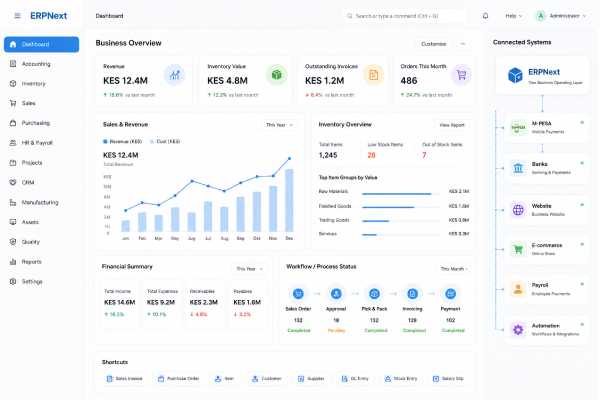
ERPNext

Our lead ERP platform. Open source, flexible and highly customisable for growing businesses.

ERP Systems Solutions with Odoo, Digital 4 Africa
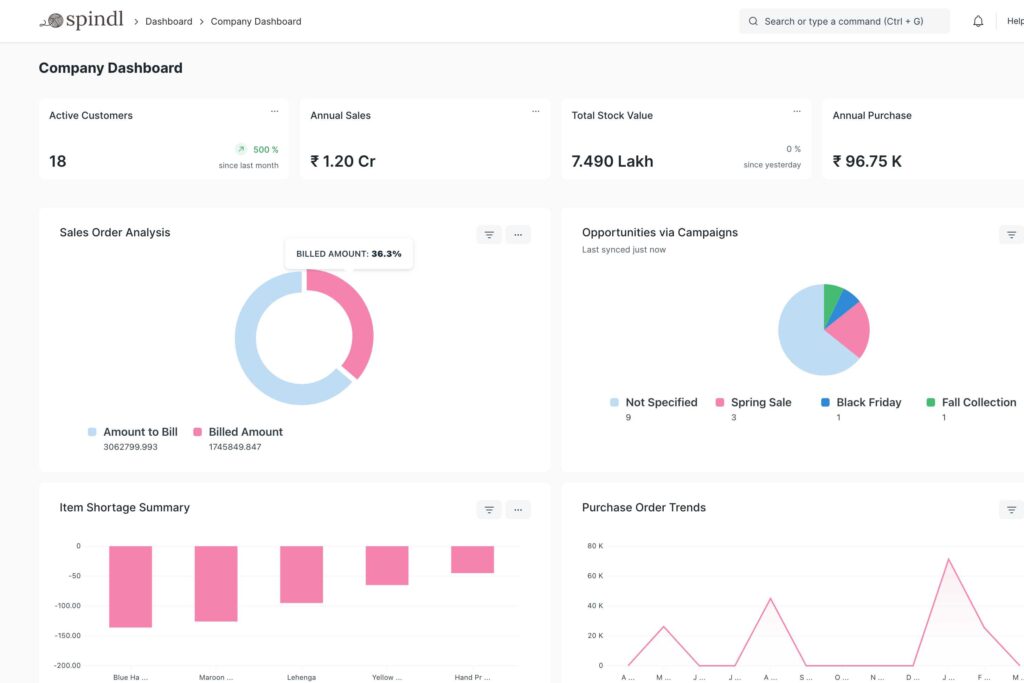
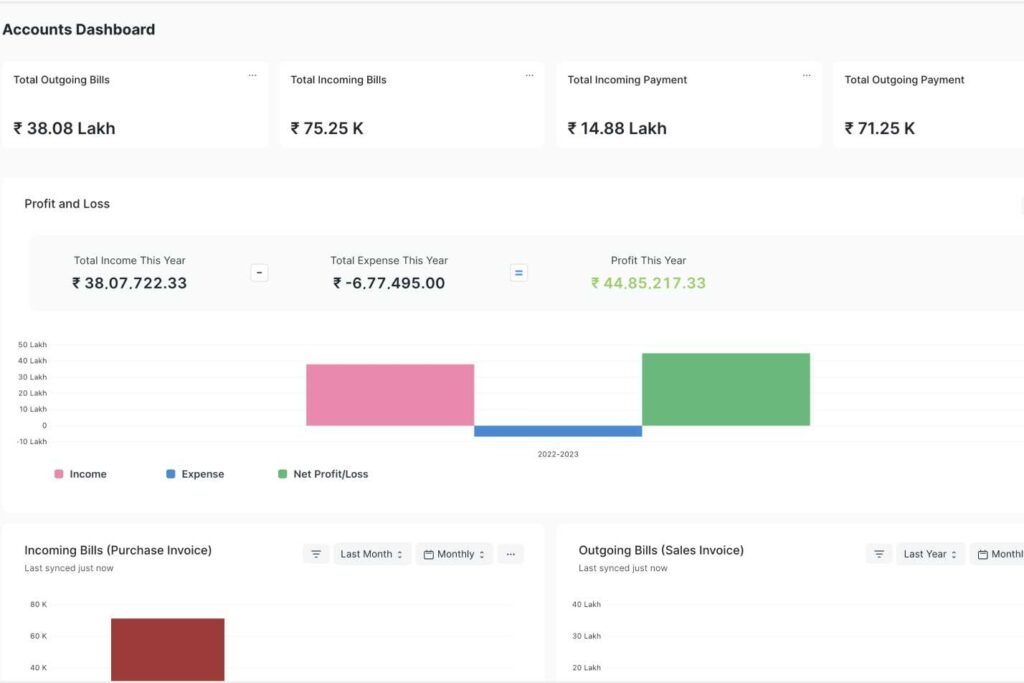
Odoo

A modular ERP platform covering accounting, sales, inventory, manufacturing, projects and more.

ERP Systems Solutions with Dynamics 365, Digital 4 Africa
Microsoft Dynamics 365

A strong option for organisations already invested in Microsoft 365, Azure, Teams and Power BI.

ERP Systems Solutions with Sage Digital 4 Africa
Sage

Established business software with strong accounting and financial management capabilities.

ERP Systems Solutions with Zoho Digital 4 Africa
Zoho

A broad cloud business suite that can suit smaller organisations and less complex ERP requirements.

ERP Systems Solutions with ERPNext
SAP Business One

A well-established ERP option for growing and mid-sized organisations that need structured financial, operational and business management processes.

We do not recommend an ERP because it is fashionable. We recommend the platform that fits your business, budget, processes, integrations and growth plans.

For many growing Kenyan businesses, ERPNext provides an unusually strong combination of functionality, flexibility and ownership economics. For others, Odoo, Dynamics 365, Sage, SAP Business One or Zoho may be the better choice.

Why We Lead With ERPNext

Open source gives growing businesses room to build

A Flexible ERP for Growing Businesses

ERPNext is our lead ERP platform because it gives us a flexible foundation for implementation, integration and customisation.

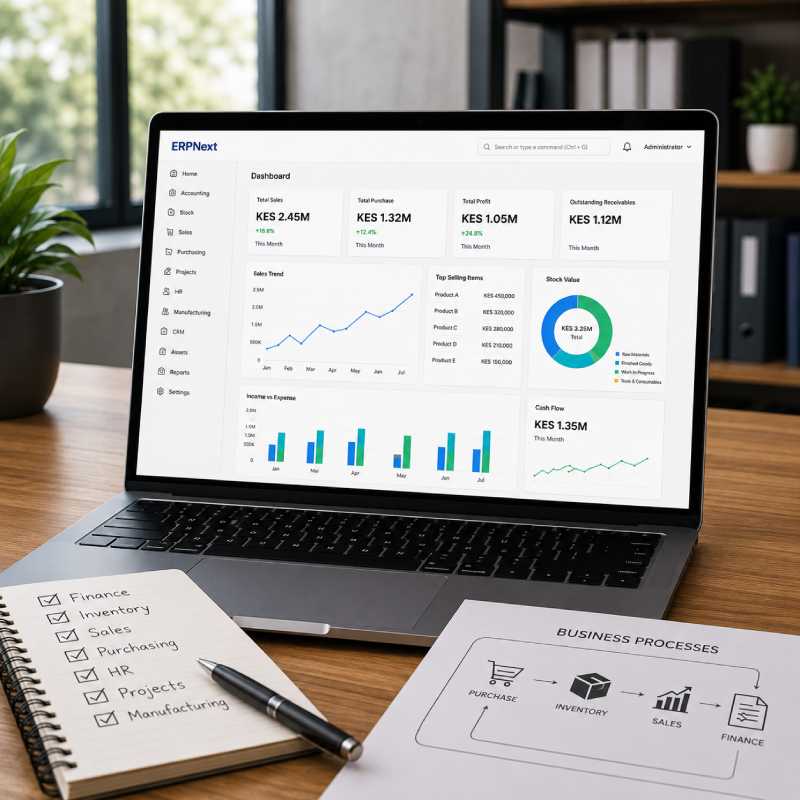
It covers core areas such as accounting, inventory, purchasing, selling, manufacturing, projects, HR and payroll while allowing businesses to extend the system when their processes require more.

For organisations that need an ERP without locking every employee behind an additional per-user software licence, the open-source model can also make the economics attractive.

ERP Systems Solutions with EPR Next, Digital 4 Africa

ERPNext Implementation in Kenya

The value of ERPNext depends heavily on how it is implemented.

We configure the platform around your chart of accounts, inventory structure, workflows, permissions, reports and operational processes. Where required, we can also connect ERPNext to local payment and compliance systems, websites, other applications and automation workflows.

That means an ERPNext implementation can be more than installing software. It can become the operating layer connecting the business.

ERP Systems Solutions with Microsoft, Zoho, Hubspot, Digital 4 Africa

When ERPNext Is Not the Right Choice

ERPNext is not automatically the right ERP for every organisation.

If your company is deeply invested in Microsoft technologies, Dynamics 365 may provide a more natural ecosystem. If you need a particular industry capability or prefer Odoo’s modular ecosystem, Odoo may be a better fit. Larger organisations may also have reasons to consider SAP Business One or other enterprise platforms.

Our job is to recommend the right system, not simply the system we happen to sell.

Brand Haven Limited

ERP for Different Industries

The ERP should reflect the business, not the other way around.

ERP Trends for 2026

ERP is moving from record keeping towards intelligent operations

Cloud ERP

Cloud deployment has become the default direction for modern ERP, reducing infrastructure burden and making systems easier to access across locations.

AI-Powered ERP

AI is increasingly being embedded into ERP for assistance, analysis, forecasting, document processing and workflow execution.

Automation

Businesses are automating repetitive finance, procurement, reconciliation, reporting and approval processes.

Connected ERP

Modern ERP increasingly operates as part of a connected ecosystem of APIs, specialised applications and automation platforms.

The important point is not to add AI or automation simply because they are fashionable. The value comes from identifying repetitive or information-heavy processes where better data, automation or AI can produce a measurable improvement.

Case Study: Brand Haven Limited

Turning a busy Nairobi print floor into a process you can see.

Brand Haven Limited is a Nairobi branding and printing company serving clients across East Africa.

Printing is a deceptively complex business. A single job can move through enquiry, artwork, quotation, approval, production, quality control and delivery, with different people and materials involved at every stage.

The challenge was not simply to install software. We started by mapping how the business actually worked and structuring the operation into clear stages.

That process map became the foundation for the ERP configuration.

The result is an operation where a job has one record, one status and one owner at each stage. Quotations follow a standard structure. Teams can see where work is. And the front desk can answer questions about an order without physically walking to the production floor.

The lesson is straightforward: an ERP implementation should digitise a good process, not simply digitise confusion.

Brand Haven Limited
Brand Haven Limited2

How Much Does an ERP Cost in Kenya?

A useful starting point is better than a mysterious quote.

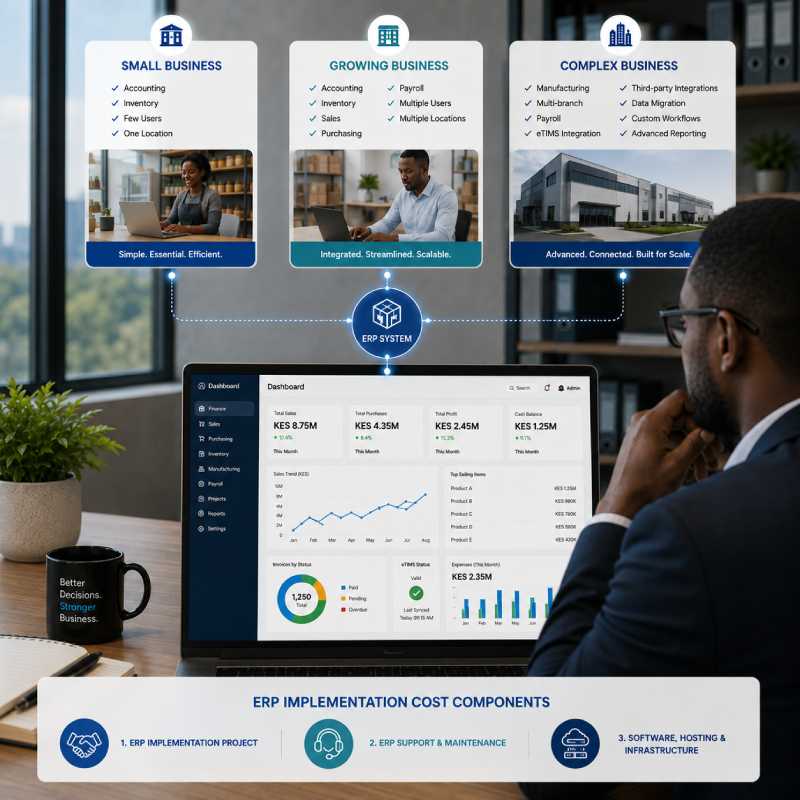
ERP pricing depends on the platform, number of modules, users, branches, integrations, data quality, customisation and support requirements.

For Digital 4 Africa, ERP implementation projects start from approximately KES 65,000. That is a starting point, not a fixed price for every implementation.

A small business with accounting and inventory may have a very different project from a multi-branch manufacturer requiring manufacturing, payroll, eTIMS, integrations, data migration and extensive workflow customisation.

ERP CRM Solutions for Modern African Businesses

1. ERP Implementation Project

A one-off project covering discovery, installation, configuration, localisation, data migration, training and go-live preparation. ERP implementations start from KES 65,000.

2. ERP Support & Maintenance

Implementation support is available from KES 35,000 per month, depending on the required level of support, system complexity and ongoing development needs.

3. Software, Hosting & Infrastructure

Software subscriptions, cloud hosting, infrastructure and third-party services are priced separately according to the selected ERP platform and architecture.

Let's Put Your Business on the Right ERP

Start with your business process, not a software sales pitch.

Most ERP projects become expensive when software is selected before anyone properly understands the business. We work the other way round. We start by understanding how your business operates, where information gets lost, what people are retyping, where processes are slow, what systems need to connect and what your management needs to know. Then we recommend the ERP platform, implementation approach and integrations that make sense.

ERP CRM Solutions for Modern African Businesses

Frequently Asked Questions About ERP Systems

Straight answers to common ERP questions

An ERP system is software that connects core business functions such as accounting, inventory, purchasing, sales, manufacturing, projects and HR through a shared system and database.

There is no single best ERP for every Kenyan business. ERPNext is our lead platform because of its breadth, flexibility and open-source model. Odoo, Microsoft Dynamics 365, Sage, SAP Business One and Zoho can also be appropriate depending on the organisation’s requirements, budget, existing systems and growth plans.

Yes. ERPNext can be implemented for businesses operating in Kenya, with configuration and integration required for local business processes and requirements such as accounting, payroll, payments and eTIMS.

ERP and invoicing systems can integrate with KRA eTIMS through system-to-system integration mechanisms such as OSCU and VSCU, subject to the applicable technical, onboarding and certification requirements. We can help design and implement the ERP integration around those requirements.

Yes. ERP systems can be integrated with M-Pesa and other payment services through available APIs and integration methods. The exact implementation depends on the payment workflow and the systems involved.

Digital 4 Africa ERP implementation projects start from approximately KES 65,000. The final cost depends on modules, branches, users, data migration, integrations, customisation, training and other project requirements.

Implementation time depends heavily on scope. A relatively simple ERP deployment can be phased quickly, while a multi-branch implementation involving manufacturing, complex integrations, data migration and extensive customisation will require substantially more planning and testing.

Yes. Data migration can include customers, suppliers, products, stock, opening balances and other records. We also recommend cleaning and validating data before migration so that poor legacy data does not become poor ERP data.

Yes. ERP support can include troubleshooting, configuration changes, reports, workflows, training, upgrades, maintenance, security and ongoing development.

Yes. Modern ERP environments increasingly incorporate AI for analysis, forecasting, document processing, workflow assistance, automation and other operational tasks. We can also connect ERP data with external AI and automation tools where that provides a practical business benefit.