
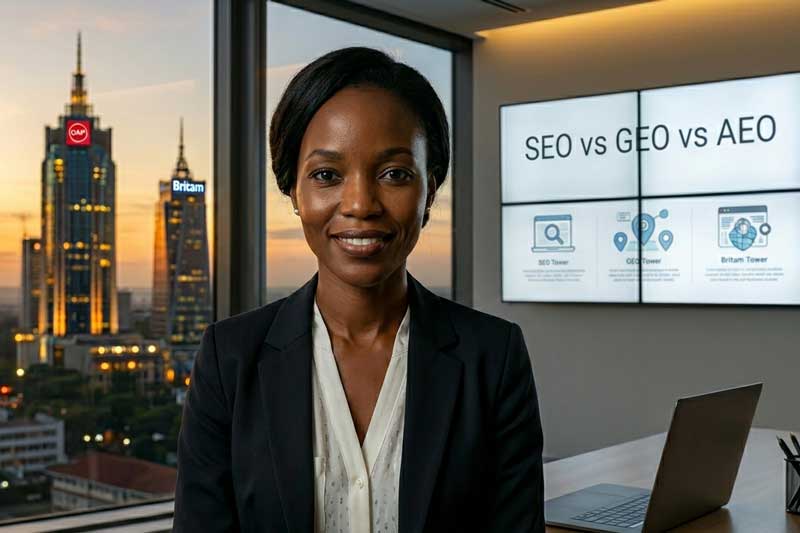
GEO and AEO: The Complete Guide to Optimizing for AI-Powered Search in 2026
Your complete guide to getting your business recommended by ChatGPT, Claude, Gemini, Grok, Perplexity, and Google AI Overviews — and why traditional SEO alone won’t cut it anymore.
Table of Contents
- Summary
- Introduction: The Search Landscape Has Fundamentally Changed
- What Is GEO (Generative Engine Optimization)?
- What Is AEO (Answer Engine Optimization)?
- What Is SEO (Search Engine Optimization)?
- SEO vs. AEO vs. GEO: What’s the Difference?
- How Generative AI Engines Select and Cite Sources
- GEO & AEO Research Tools
- Core GEO Optimization Strategies
- Technical GEO: The Infrastructure Layer
- AEO Optimization Strategies
- How to Get ChatGPT, Claude, Gemini, and Grok to Recommend Your Company
- Measuring GEO and AEO Success: The New KPIs
- Common GEO Mistakes to Avoid
- The Future of GEO and AEO
- Conclusion: Your Action Plan
- Frequently Asked Questions
Summary
The way people find businesses, products, and information online has fundamentally changed. In 2026, millions of people no longer type queries into Google and click through ten blue links. They ask ChatGPT. They prompt Claude. They use Perplexity. They rely on Google’s AI Overviews to give them the answer directly — no click required.
This shift has created two new disciplines that every business owner, marketer, and SEO professional in Kenya and Africa needs to understand:
GEO (Generative Engine Optimization) is the practice of optimizing your content and digital presence so that AI platforms like ChatGPT, Claude, Gemini, Grok, and Perplexity cite, reference, or recommend your business when users ask questions in your industry.
AEO (Answer Engine Optimization) is the practice of structuring your content so it gets extracted and displayed as a direct answer in search features like Google’s AI Overviews, featured snippets, People Also Ask boxes, and voice assistant responses.
Both share the same goal: making your business the answer, not just a search result.
This guide covers everything: what GEO and AEO actually are, how they differ from traditional SEO, the practical strategies to implement them, the tools to use, how to measure results, and — crucially — how to get AI assistants like ChatGPT, Claude, Gemini, and Grok to actively recommend your company or organization when someone asks for help in your space.
If you run a business in Kenya or Africa, this is arguably the biggest digital marketing opportunity on the continent right now. Almost nobody here is doing it. That window won’t stay open forever.
Introduction: The Search Landscape Has Fundamentally Changed
Where were you on November 30th, 2022? I certainly don’t remember. It’s the day ChatGPT 3.5 was launched to the public. Since then, the way human beings interact with information has changed more dramatically than at any point since Google itself launched in 1998.
Here’s what’s happened since that day:
ChatGPT crossed 100 million users in two months — the fastest adoption of any technology in human history. Google responded with AI Overviews, which now appear at the top of most search results, giving users answers directly without needing to click on anything. Perplexity emerged as a full AI-powered search engine. Claude, Gemini, Grok, and Copilot all became places where people go to ask questions and get answers. Microsoft integrated AI into Bing. Apple integrated AI into Siri.
The result? Over 60% of Google searches now end without a single click to any website. Gartner has projected a 25% decline in traditional search volume by 2026 as users shift to AI-generated answers. And AI Overviews have been shown to reduce click-through rates for top-ranking content by as much as 58%.
Let that sink in. You could be ranked number one on Google and still be invisible to a growing percentage of your potential customers — because they’re getting their answer from AI before they ever see your link.
For years, the game was simple: rank on Google, get clicks, convert customers. That game isn’t dead, but it’s no longer the only game. A new layer has been added, and if you’re not playing it, you’re leaving money, visibility, and authority on the table.
This is the world of GEO and AEO. And this guide is going to walk you through it — no fluff, no hype, just what works and how to do it.
What Is GEO (Generative Engine Optimization)?
Generative Engine Optimization (GEO) is the practice of optimizing your content and digital presence so that AI-powered platforms — ChatGPT, Claude, Gemini, Grok, Perplexity, and Google AI Overviews — cite, reference, or recommend your brand when users ask questions.
The term originates from a 2023 research paper by Aggarwal, Murahari, and colleagues at Princeton University and Georgia Tech, published at KDD 2024. Their framework, GEO-Bench, tested optimization strategies across 10,000 queries. The findings were significant: specific optimization strategies could boost visibility in AI responses by up to 40%.
But here’s the insight that should keep every marketer awake at night: the researchers found that pages ranked fifth in traditional Google search saw a 115% increase in visibility when properly optimized for AI. Meanwhile, pages ranked first in traditional search actually saw their AI visibility drop by 30%.
Read that again. Being number one on Google doesn’t mean the AI will recommend you. And being on page two of Google doesn’t mean the AI won’t.
This is a completely different game.
How Generative Engines Work
When someone asks ChatGPT or Perplexity a question, the AI doesn’t just paste the query into a search engine and return the first result. Here’s what actually happens:
Query fan-out. The AI breaks your question into multiple sub-queries and searches for each one separately. If you ask “What’s the best digital marketing agency in Nairobi for an SMB?”, it might separately search for digital marketing agencies in Nairobi, reviews and mentions of those agencies across the web, what services SMBs typically need, and then cross-reference all of that.
Multi-source synthesis. The AI pulls information from dozens of sources — your website, third-party review sites, social media mentions, industry publications, forums like Reddit and Quora, and its own training data — and synthesizes it into a single, coherent answer.
Citation selection. The AI decides which sources to cite or recommend based on signals like authority, freshness, clarity, and how well the information matches the query. This is where GEO comes in: you’re optimizing to be one of those selected sources.
The fundamental shift is this: in traditional SEO, you’re competing for a position on a results page. In GEO, you’re competing to be part of the answer itself.
What Is AEO (Answer Engine Optimization)?
Answer Engine Optimization (AEO) is the practice of structuring your content so it gets extracted and surfaced as a direct answer in search features — featured snippets, People Also Ask boxes, Google’s AI Overviews, voice assistant responses, and AI answer boxes.
AEO has been around longer than GEO. It emerged when Google started answering questions directly on the search results page, pulling content from websites and displaying it in featured snippets. If you’ve ever Googled a question and seen the answer sitting right there at the top — a short paragraph, a numbered list, a table — that’s AEO in action.
In 2026, AEO has expanded beyond snippets. It now includes optimization for Google’s AI Overviews (the AI-generated summary that appears above all search results), voice search responses from Siri, Alexa, and Google Assistant, and the AI-powered answer boxes that Bing and other search engines display.
How AEO Differs from GEO
The distinction is straightforward:
AEO focuses on getting your content extracted as a direct answer within traditional search engines — Google, Bing — and their AI-enhanced features. You’re still operating within the search engine ecosystem.
GEO focuses on getting your content cited within standalone AI platforms — ChatGPT, Claude, Perplexity, Gemini — that operate independently of Google. You’re operating in a completely different ecosystem.
The overlap is significant. Content that’s well-structured for AEO tends to perform better in GEO too. But they’re not identical. A piece of content might be perfectly optimized for a Google featured snippet (AEO) but invisible to ChatGPT (GEO) because ChatGPT uses different signals, training data, and selection criteria.
A smart digital strategy in 2026 includes both.
What Is SEO (Search Engine Optimization)?
If you’re reading this article, you probably know what SEO is. But it’s worth defining it here because the relationship between SEO, AEO, and GEO is critical.
Search Engine Optimization (SEO) is the practice of optimizing your website and content to rank higher in traditional search engine results — primarily Google. It’s been the backbone of digital marketing for over two decades. SEO involves keyword research, on-page optimization, link building, technical site performance, and content strategy.
SEO is not dead. Let’s be very clear about that. Google still processes billions of searches daily, and organic traffic from Google remains one of the most valuable channels for any business. What’s changed is that SEO alone is no longer enough.
Think of it this way: SEO is the foundation. AEO is the ground floor. GEO is the upper floors. You can’t build the upper floors without the foundation, but if you only have the foundation, you’re missing the building.
SEO vs. AEO vs. GEO: What’s the Difference?
All three share the same ultimate goal — making your business visible to people looking for what you offer. But they do it in different ways, on different platforms, and with different metrics.
| SEO | AEO | GEO | |
|---|---|---|---|
| Goal | Rank high in search results | Be the direct answer in search features | Be cited/recommended by AI platforms |
| Where | Google, Bing (blue links) | Google AI Overviews, featured snippets, voice assistants | ChatGPT, Claude, Gemini, Grok, Perplexity |
| Key Metric | Rankings, organic traffic, CTR | Featured snippet wins, zero-click visibility | Share of Voice, citation frequency, AI mentions |
| Content Style | Keyword-optimized, link-worthy | Question-and-answer format, concise, structured | Authoritative, well-cited, entity-clear, third-party validated |
| What You Compete For | A position on the results page | The answer box at the top | A place in the AI’s generated response |
| Timeline to Results | 3–12 months | 1–6 months | 3–6 months (ongoing) |
The Three-Layer Strategy
Here’s how the three work together:
Layer 1: SEO builds your baseline visibility. Strong SEO fundamentals — good site architecture, quality content, backlinks, technical performance — create the authority signals that both AEO and GEO rely on. AI models frequently use live web search as part of their response generation. If your content ranks well on Google, AI crawlers are more likely to find it and assess it as trustworthy.
Layer 2: AEO captures the zero-click layer. Even when people still use Google, they increasingly get their answer from the AI Overview or featured snippet without clicking through. AEO ensures you’re the source that gets extracted.
Layer 3: GEO captures the AI-native audience. These are the people who skip Google entirely and go straight to ChatGPT, Claude, or Perplexity. GEO ensures your brand shows up in those conversations.
None of the three works in isolation. A business with great SEO but no GEO strategy is invisible to the growing AI-native audience. A business focused on GEO but with poor SEO fundamentals lacks the authority signals that AI platforms use to decide who to cite.
The complete formula is: SEO + AEO + GEO.
How Generative AI Engines Select and Cite Sources
Understanding how AI engines decide what to cite is the foundation of effective GEO. If you don’t understand the machine, you can’t optimize for it.
Retrieval-Augmented Generation (RAG), Simply Explained
Most AI assistants don’t just answer questions from memory. They use a process called Retrieval-Augmented Generation, or RAG. Here’s the simplified version:
- You ask a question. “What’s the best CRM for small businesses in Kenya?”
- The AI searches. It sends out multiple queries across the web, its own indexes, and its knowledge base.
- The AI retrieves relevant content. It pulls in information from various sources — articles, company websites, reviews, forum posts, databases.
- The AI generates a response. It synthesizes all that retrieved information into a single, coherent answer, often citing the sources it used.
The critical step is retrieval. The AI has to find your content, determine that it’s relevant and trustworthy, and then decide to include it in the response. GEO is about influencing that decision at every stage.
What Signals AI Engines Use
While nobody outside of OpenAI, Anthropic, or Google knows the exact algorithms, research and industry observation have identified several key signals:
Authority. AI engines favor content from established, credible sources. This includes strong domain authority, quality backlinks, expert authorship, and brand recognition across the web.
Freshness. Up-to-date content gets preferred, especially for topics where information changes. A 2024 article about CRM pricing is less likely to be cited than a 2026 one.
Entity clarity. AI systems need to understand exactly who you are and what you do. If your brand, your services, and your expertise are clearly and consistently described across the web, AI engines can confidently attribute information to you.
Third-party mentions. This is huge. AI engines don’t just look at what you say about yourself on your own website. They look at what others say about you — reviews, press mentions, forum discussions, social media, industry publications. If your brand is being talked about positively across multiple independent sources, AI engines are far more likely to recommend you.
Structured data. Schema markup, clear content hierarchy, and structured formatting help AI systems accurately extract and attribute information from your pages.
Citation quality in your own content. Content that includes credible citations, statistics, and references to authoritative sources is more likely to be treated as authoritative itself. The Princeton GEO-Bench study found that adding citations to your content was one of the most effective optimization tactics.
Why AI Results Are Probabilistic
Here’s something that catches many people off guard: AI results are not deterministic. The same question asked twice on ChatGPT can produce different answers with different sources cited. Research shows that between 40% and 60% of cited sources change month-to-month across platforms like Google AI Mode and ChatGPT.
This means GEO is not like traditional SEO, where you aim for a fixed position. It’s more like brand marketing — you’re building the conditions that make it increasingly likely that AI engines will mention you, across many queries, over time. Consistency and persistence matter more than any single tactic.
GEO & AEO Research Tools
Before you optimize, you need to research. You need to understand what AI engines are currently saying about your industry, your competitors, and your brand. Here’s how.
Using Perplexity for GEO Research
Perplexity is one of the most powerful free tools for GEO research because it shows you exactly what AI-powered search looks like in practice — complete with cited sources.
Here’s how to use Perplexity for GEO research:
Step 1: Query your industry. Type the kinds of questions your potential customers would ask. If you run a digital marketing agency in Nairobi, search for: “What are the best digital marketing agencies in Nairobi?” “Who offers SEO services in Kenya?” “How do I grow my business online in East Africa?”
Step 2: Analyze the results. Look at what sources Perplexity cites. Which companies are being mentioned? Which websites are being referenced? What type of content gets pulled in — blog posts, service pages, reviews, directories?
Step 3: Identify gaps. If your business isn’t appearing but your competitor is, study what they have that you don’t. Is it a well-structured service page? Third-party reviews? Industry directory listings? Guest posts on authoritative sites?
Step 4: Map the questions. Compile a list of every question a potential customer might ask an AI assistant about your industry. These are your content targets.
Using ChatGPT, Claude, and Gemini for Research
Do the same exercise across all major AI platforms. Ask each one the same set of questions about your industry and note:
- Which brands get mentioned and which don’t
- How your brand is described (if mentioned at all)
- What sources are being cited
- Whether the information about you is accurate
- Whether competitors are being recommended over you
This cross-platform analysis gives you a baseline. It tells you exactly where you stand in the AI landscape right now.
Other GEO Research and Monitoring Tools
The GEO tooling market is evolving rapidly. Here are some notable platforms as of 2026:
Semrush AI Visibility Toolkit — tracks brand mentions, citations, and share of voice across AI platforms. One of the most comprehensive enterprise options.
Peec AI — monitors where your content appears in AI-generated responses across ChatGPT, Google AI Overviews, Gemini, Perplexity, and more.
Profound — offers AI search benchmarking and competitive analysis across LLM-powered platforms.
OtterlyAI — automates prompt-based monitoring and citation tracking across major AI search engines.
Scrunch — provides AI visibility tracking and content optimization recommendations.
For many Kenyan businesses just starting out, the free approach — manually querying AI platforms with your target questions — is a perfectly valid starting point. You don’t need an enterprise tool to begin. You need curiosity and a spreadsheet.
Core GEO Optimization Strategies
This is where theory meets practice. These are the strategies that actually move the needle on AI visibility.
1. Target Topics, Not Just Keywords
Traditional SEO trained us to think in keywords: “best CRM Kenya,” “digital marketing Nairobi,” “web design services.” Keywords still matter for Google, but AI engines think in topics and intent.
When someone asks ChatGPT “How should a small business in Nairobi manage customer relationships?”, the AI isn’t matching keywords. It’s understanding the topic — CRM for Kenyan SMBs — and pulling from content that comprehensively addresses that topic.
This means your content strategy should be built around thorough coverage of specific topics. Don’t write a 300-word page targeting “CRM Kenya.” Write a comprehensive guide that covers what CRM is, why it matters for Kenyan businesses, how M-Pesa integration works with popular CRMs, pricing in KES, implementation challenges for African SMBs, and real case studies.
Depth and completeness win in GEO. The AI is looking for the most informative, accurate, and complete source to cite. Be that source.
2. Structure Content for Extraction
Generative AI engines are synthesizers. They extract key information from your content and reassemble it into their response. The easier you make it for them to extract, the more likely you are to be cited.
What this looks like in practice:
Use clear heading hierarchies (H2, H3, H4) that describe the content beneath them. The AI uses headings to understand topic structure.
Lead with direct answers. If your heading is “How Much Does SEO Cost in Kenya?”, the very next sentence should answer the question: “SEO services in Kenya typically range from Ksh 30,000 to Ksh 250,000 per month depending on scope, industry, and agency experience.” Then elaborate.
Keep paragraphs focused and concise. Each paragraph should make one clear point. Long, meandering paragraphs are harder for AI to extract from cleanly.
Use lists and tables for comparative information. When comparing options, pricing tiers, or features, structured formats are significantly easier for AI to parse accurately.
3. Add Citations, Statistics, and Expert Quotes
The Princeton GEO-Bench research found that adding credible citations to your content was one of the single most effective GEO tactics. Content with statistics, data points, and references to authoritative sources is treated as more credible by AI systems.
This means: don’t just say “Digital marketing is growing in Kenya.” Say “According to the Communications Authority of Kenya, internet penetration reached 53.7% in 2025, with mobile internet driving the majority of online activity — making digital marketing increasingly essential for Kenyan businesses.”
Include data from recognized institutions: KNBS, the CBK, the World Bank, industry reports from McKinsey or Deloitte on African markets. Link to your sources. This isn’t just good GEO — it’s good writing.
4. Build Topical Authority
AI engines don’t just evaluate individual pages. They evaluate entire websites and brands for topical authority. If your website has one blog post about SEO and fifty posts about cooking, the AI is unlikely to cite you as an SEO authority.
Build clusters of content around your core topics. If you’re a digital marketing agency, you should have comprehensive, interlinked content covering SEO, social media marketing, Google Ads, content strategy, email marketing, and — yes — GEO and AEO. Each piece should link to related pieces on your site, creating a web of interconnected expertise.
This signals to AI systems that you’re not a casual commentator — you’re an authority.
5. Entity Grounding: Make Your Brand Unambiguous
AI systems need to understand exactly what your brand is. This is called entity grounding. If your business name is common, or your services could be confused with other companies, AI engines may struggle to associate the right information with you.
How to strengthen your entity:
Maintain consistent NAP (Name, Address, Phone) information across your website, Google Business Profile, social media, directories, and every platform where your brand appears.
Create or claim your brand’s knowledge panel on Google. This is often the starting point for AI systems trying to understand who you are.
Use “About” pages and author bios that clearly state who you are, what you do, and what your expertise is. Schema markup (which we’ll cover in the technical section) reinforces this.
Be consistent in how you describe your services. If you call it “digital marketing” on your website but “online marketing” on LinkedIn and “internet marketing” on your Google Business Profile, you’re creating noise. Pick your terms and stick with them.
6. Invest Beyond Your Website
Here’s where many businesses get it wrong: they focus exclusively on their own website and wonder why AI doesn’t mention them. AI engines evaluate your brand across the entire web — not just your domain.
Get reviewed. Actively seek reviews on Google, Clutch, Trustpilot, and industry-specific directories. AI systems frequently pull from review platforms when making recommendations.
Get mentioned. Guest post on relevant industry blogs. Get quoted in press articles. Contribute to forums and discussions where your expertise is relevant. Participate in industry roundups.
Get listed. Make sure your business appears in relevant directories — both global (Clutch, G2, Crunchbase) and Kenya/Africa-specific (Africa Business Directory, Kenya business listings).
Get discussed on social media. LinkedIn posts, Twitter/X threads, and YouTube content that mention your brand create the kind of third-party signals that AI engines pay attention to.
A significant portion of what AI knows about your brand comes from what other people say about you, not what you say about yourself. This is digital PR, and it’s now a GEO strategy.
Technical GEO: The Infrastructure Layer
Most GEO conversations focus on content. That’s important, but it’s only half the story. The technical infrastructure of your website determines whether AI systems can even find, access, and understand your content in the first place.
Schema Markup for AI
Schema markup is structured data that you add to your website’s code to help search engines and AI systems understand your content. Think of it as labelling everything on your site in a language that machines speak fluently.
Here’s why it matters for GEO: A study by Semrush found that when GPT-4 processed content with proper Schema markup, the accuracy of information extraction jumped from 16% to 54%. That’s not a marginal improvement. That’s the difference between the AI misunderstanding your page and the AI getting it right.
Priority schema types for GEO:
Organization — tells AI who your company is, where you’re located, what you do, your logo, social profiles, and contact information.
Article — tells AI that a page is an article, who wrote it, when it was published, and when it was last updated.
FAQPage — tells AI that a page contains frequently asked questions and their answers. This is particularly powerful for both AEO and GEO.
Person — establishes author credibility. If your team members are writing content, Person schema connects them to their expertise and credentials.
LocalBusiness — critical for Kenyan businesses targeting local queries. Connects your business to a specific location, service area, and category.
If you’re on WordPress, plugins like RankMath and Yoast make implementing schema markup relatively straightforward. If you’re on a custom build, your developer needs to implement JSON-LD structured data.
Implementing llms.txt
This is an emerging standard that most businesses haven’t heard of — which makes it an opportunity.
llms.txt is a plain text file you place at your domain root (e.g., yourdomain.co.ke/llms.txt) that provides AI systems with curated information about your organization. Think of it as a robots.txt file, but specifically designed for large language models. It’s essentially a README for AI crawlers.
In your llms.txt file, you list your most important pages in priority order, provide short descriptions of what each resource contains, and point AI systems to your canonical content. This helps AI systems land on the right pages when they crawl your site, rather than getting lost in your archives or pulling from outdated content.
As of 2026, llms.txt is still an emerging convention — not universally adopted, not guaranteed to be read by every AI system. But implementing it is simple, costs nothing, and positions you ahead of virtually every competitor in the Kenyan and African market.
Robots.txt and CDN Configuration
Here’s something that trips up a lot of businesses: AI bots might be blocked from accessing your website entirely, and you wouldn’t know it.
If you use Cloudflare (which many Kenyan websites do), your AI bot traffic may have been blocked automatically by Cloudflare’s bot management settings. Check your server logs. Look for the “ChatGPT-User” user agent. If you don’t see it, AI bots aren’t getting through.
Similarly, review your robots.txt file. If it blocks crawlers broadly, you might be preventing AI systems from indexing your content. Make sure AI crawlers like GPTBot (OpenAI), ClaudeBot (Anthropic), and Google-Extended (Google AI) are allowed access.
This is the most common technical GEO issue. You can have the best content in the world, but if the AI can’t reach it, you’re invisible.
Site Speed, Mobile-Friendliness, and Crawlability
These are traditional SEO fundamentals, but they directly impact GEO:
Fast-loading pages are more efficiently crawled by AI bots. If your site takes 8 seconds to load, AI crawlers may time out or deprioritize your content.
Mobile-friendly design matters because Google’s AI systems crawl the mobile version of your site first.
Clean site architecture — logical URL structures, proper internal linking, XML sitemaps — helps AI systems discover and understand the full scope of your content.
If your technical SEO house isn’t in order, your GEO efforts will be limited regardless of how good your content is. Fix the foundation first.
AEO Optimization Strategies
While GEO targets AI platforms like ChatGPT and Claude, AEO targets the AI-enhanced features within traditional search engines — primarily Google. Here’s how to optimize for them.
Write Content Around Specific, Searchable Questions
AEO is fundamentally about answering questions. The content that gets extracted for featured snippets, People Also Ask boxes, and AI Overviews is content that clearly and directly answers a specific question.
Use tools like Google’s “People Also Ask” feature, AnswerThePublic, AlsoAsked, and Semrush’s keyword research tools to identify the exact questions your audience is asking. Then create content that answers those questions directly and comprehensively.
For Kenya-focused businesses, think about questions like: “How do I register a business in Kenya?”, “What is the best M-Pesa payment integration for my website?”, “How much does it cost to build a website in Kenya?” These are the kinds of queries that trigger AI Overviews and answer boxes.
Use Headers That Mirror Natural Search Queries
Your H2 and H3 headings should look like the questions people actually type or speak. Instead of a heading like “Our Pricing,” use “How Much Does Digital Marketing Cost in Kenya?” Instead of “Services,” use “What Digital Marketing Services Does [Your Brand] Offer?”
This alignment between heading and search query dramatically increases your chances of being selected for a featured snippet or AI Overview.
Implement FAQ and HowTo Schema
FAQ schema tells Google exactly which questions your page answers and what the answers are. HowTo schema tells Google that your page contains step-by-step instructions. Both significantly increase your eligibility for rich results and AI-enhanced features.
If your page has a FAQ section (and most service pages and blog posts should), wrap it in FAQPage schema. If your page contains a tutorial or guide, use HowTo schema. These are among the most impactful structured data types for AEO.
Structure Answers in the Inverted Pyramid
Journalists have used the inverted pyramid for a century: put the most important information first, then add detail. AI systems love this structure because they can extract the core answer from the opening sentence without needing to parse through context and background.
For every question you answer in your content, lead with a clear, concise answer in one or two sentences. Then expand with context, examples, data, and nuance. The AI might only extract your first sentence — make it count.
How to Get ChatGPT, Claude, Gemini, and Grok to Recommend Your Company
This is the section everyone wants to read. Let’s get practical.
Getting AI platforms to actively recommend your business is not about gaming a system. It’s about building the conditions that make your business the most logical, credible, and well-documented recommendation. Here’s how.
1. Be the Most Comprehensive, Authoritative Source in Your Niche
AI systems recommend sources they trust. Trust comes from depth, accuracy, and consistency. If you’re a web development agency in Kenya, your website should be the most comprehensive resource on web development in the Kenyan market. Cover every aspect: pricing, technologies, case studies, FAQs, comparisons, trends.
When ChatGPT needs to answer “Who does web development in Nairobi?”, it’s going to pull from whatever sources have the most substantial, well-organized, and frequently cited content on that topic.
2. Build a Third-Party Footprint
This cannot be overstated. AI engines don’t just trust what you say about yourself. They verify it through third-party sources.
Get your business listed on review platforms: Google Reviews, Clutch, G2, Trustpilot. Actively solicit reviews from happy clients. Get mentioned in industry publications and blogs — both Kenyan and international. Contribute expert quotes to journalists. Be active and visible on LinkedIn, Twitter/X, and YouTube.
Every independent mention of your brand across the web is a signal to AI systems that your brand is real, active, and recognized by others. This is perhaps the single most important thing you can do for GEO.
3. Create Content That AI Can Confidently Attribute
AI systems are cautious. They don’t want to cite information that might be inaccurate or misleading. Content that includes clear author attribution, publication dates, credible citations, and factual accuracy is far more likely to be cited than anonymous or unsourced content.
Make sure every piece of content on your site has a clear author with a bio that establishes their expertise. Include publication dates and “last updated” dates. Back up claims with data and cite your sources.
4. Own Your Brand’s Knowledge Graph
When an AI is asked about your company, it looks for consistent, authoritative signals about who you are. Make sure your Google Business Profile is complete and accurate. Ensure your LinkedIn company page is detailed. If your brand has a Wikipedia page or a Crunchbase profile, keep it current.
The more consistently and clearly your brand identity is documented across the web, the more confidently AI systems will recommend you.
5. Maintain Accurate, Fresh Information
AI engines prioritize fresh content. If your website hasn’t been updated since 2023, your pricing is outdated, or your case studies are three years old, AI systems will deprioritize you in favor of competitors with current information.
Regularly update your key pages — service pages, pricing, case studies, blog posts. Update your “last modified” metadata when you make changes. Freshness is a trust signal.
6. Answer the Questions Your Customers Ask AI
Go to ChatGPT, Claude, Gemini, and Perplexity. Ask them the questions your potential customers would ask. If your brand isn’t mentioned, study who is mentioned and why. Then create content, build presence, and earn mentions that position you to be included next time.
This is an ongoing process, not a one-time fix. AI models update their knowledge. New competitors emerge. The landscape shifts. Make this part of your regular marketing rhythm.
Measuring GEO and AEO Success: The New KPIs
Traditional SEO metrics — rankings, organic traffic, click-through rate — still matter, but they no longer capture the full picture. GEO introduces entirely new KPIs that most analytics platforms aren’t built to track.
Share of Voice (SOV) in AI
This is the primary GEO metric. Share of Voice measures how often your brand appears in AI-generated responses compared to competitors, across a defined set of queries.
Think of it as “market share of answers.” If there are 100 relevant queries in your industry and your brand appears in 15 of the AI-generated responses, your Share of Voice is 15%. Industry research suggests that category leaders typically hold 30–50% share of voice, with second and third players holding 15–25% each.
Citation Frequency and Quality
Citation frequency tracks how often your content or brand is cited as a source in AI responses. But frequency alone isn’t enough — you also need to track citation quality. Is the AI citing your most important pages? Is the information it’s pulling accurate? Is it positive?
Sentiment and Accuracy of AI Mentions
A high share of voice means nothing if the AI is describing your product as “overpriced” or “unreliable.” Monitor not just whether you’re mentioned, but how you’re mentioned. Are the mentions positive, neutral, or negative? Is the information accurate?
AI Referral Traffic
When AI platforms provide clickable source links (Perplexity does this consistently, Google AI Overviews sometimes), track that referral traffic. Check your server logs for the “ChatGPT-User” user agent. If you use Cloudflare, their AI Crawl Metrics page shows this data.
Branded Search Lift
When people see your brand recommended by an AI assistant, many will then Google your brand name to learn more. An increase in branded search queries can be a proxy indicator that your GEO efforts are working, even when you can’t directly track AI citations.
The Measurement Blind Spot
Here’s the honest truth: traditional analytics platforms like GA4 and Google Search Console cannot track most GEO metrics. They only see what happens after a click. If someone asks ChatGPT about your industry and your brand is mentioned but the user doesn’t click through to your site, your standard dashboards show nothing. You could be the most recommended brand in ChatGPT and your GA4 would show zero activity from it.
This is the “measurement blind spot” of GEO. Dedicated tools like Semrush’s AI Visibility Toolkit, Peec AI, Profound, and OtterlyAI are being built to address this gap. For now, the pragmatic approach is: manually audit AI platforms regularly with your target queries, track your branded search volume trends, and monitor your server logs for AI bot activity.
Common GEO Mistakes to Avoid
The field is new, and people are making predictable mistakes. Here’s what to watch out for.
Assuming SEO Rankings Equal AI Visibility
This is the number one mistake. Just because you rank first on Google does not mean ChatGPT will cite you. AI platforms use overlapping but different signals. Some of the most cited sources in AI responses are not the top-ranking pages in traditional Google search. Treat GEO as a distinct discipline that requires its own strategy.
Mass-Producing AI-Generated Content
The irony is palpable: using AI to churn out content at scale in the hope that AI will then cite that content. It doesn’t work. AI systems are getting better at recognizing thin, generic, AI-generated content — and they deprioritize it. What gets cited is content with genuine expertise, unique insights, original data, and real-world experience. Quality, not quantity.
Only Optimizing Your Own Website
If you spend 100% of your GEO effort on your website and 0% on building third-party presence, you’re missing the bigger picture. AI engines form their view of your brand from across the entire web. Reviews, mentions in industry publications, social media presence, directory listings — these off-site signals often matter more than on-site optimization.
Ignoring AI Bot Access
You can have the best content in the world and still be invisible to AI because your Cloudflare settings, CDN configuration, or robots.txt file are blocking AI crawlers. Check your server logs for AI bot activity. If you see nothing, investigate.
Expecting Overnight Results
GEO is not a quick fix. AI models recrawl content and update their knowledge bases over time. Plan for 3–6 months of consistent effort before seeing meaningful changes in AI visibility. This is a marathon, not a sprint.
Ignoring Citation Instability
Research shows that 40–60% of cited sources change month-to-month across major AI platforms. A source that’s cited today may not be cited next month. This means GEO requires ongoing monitoring and optimization, not a one-time project. Build it into your regular marketing workflow.
The Future of GEO and AEO
The field is moving fast. Here’s where it’s heading.
AI Personalization
AI responses are becoming increasingly personalized. The same question may produce different answers for different users based on their context, location, conversation history, and preferences. This means brands will need to cover topics from multiple angles — different use cases, different customer segments, different geographies — to capture visibility across diverse user contexts.
For Kenyan businesses, this is actually an advantage. AI systems are increasingly sophisticated about geographic context. When a user in Nairobi asks for business recommendations, the AI is likely to prioritize Kenya-specific sources. If you’ve built strong local content and presence, you’ll benefit from this personalization.
Multi-Format Content Ecosystems
Text alone is becoming insufficient. AI systems are increasingly capable of processing and referencing video, audio, and visual content. YouTube transcripts, podcast content, and even image metadata can all feed into AI knowledge bases.
Forward-thinking businesses are building content ecosystems that span text (blogs, guides), video (YouTube, TikTok), audio (podcasts), and visual (infographics, diagrams). This multi-format approach creates more surface area for AI to discover and cite your brand.
The Growing GEO Tooling Market
The market for GEO tools is exploding. In 2025, there were a handful of monitoring platforms. By mid-2026, there are dozens, with new entrants weekly. This means measurement will get easier, competition will intensify, and the businesses that move early will have a meaningful head start.
Early Movers Win Disproportionately
Here’s the competitive reality: GEO is a compounding advantage. The more an AI cites you, the more it learns to trust you, the more it cites you in the future. Brands that build AI visibility now are creating a moat that latecomers will struggle to cross.
In Kenya and across Africa, the GEO opportunity is wide open. Almost no one is doing this deliberately. The businesses that start now — building authoritative content, strengthening their third-party presence, implementing technical GEO — will be the ones that AI platforms learn to trust and recommend first.
Conclusion: Your Action Plan
If this article has done its job, you understand why GEO and AEO matter, what they are, and how they work. Now let’s turn that into action.
Start Here
Step 1: Audit your current AI visibility. Go to ChatGPT, Claude, Gemini, and Perplexity. Ask the questions your potential customers would ask. Are you being mentioned? How are you being described? Who is being recommended instead?
Step 2: Fix your SEO foundation. GEO doesn’t replace SEO — it builds on it. Make sure your site is technically sound, your content is high-quality, your schema markup is implemented, and your Google Business Profile is complete.
Step 3: Implement technical GEO. Review your robots.txt to ensure AI crawlers can access your site. Add schema markup to your key pages. Create an llms.txt file. Check your Cloudflare or CDN settings for AI bot blocking.
Step 4: Build your third-party presence. Get reviews. Get listed in relevant directories. Contribute to industry content. Build your brand’s footprint beyond your own website.
Step 5: Create GEO-optimized content. Write comprehensive, well-structured, well-cited content around the topics your audience cares about. Target topics, not just keywords. Lead with direct answers. Include data and expert insights.
Step 6: Monitor and iterate. Check your AI visibility monthly. Track your branded search trends. Review your server logs for AI bot activity. Adjust your strategy based on what you find.
The 80/20 Rule of GEO
Spend 80% of your effort on content quality and third-party presence. Spend 20% on technical optimization. The best schema markup in the world won’t help if your content is mediocre or your brand doesn’t exist outside your own website. Get the content right, build the presence, and let the technical layer amplify it.
For Kenya and Africa
If you operate in the Kenyan or African market, you’re sitting on an enormous first-mover advantage. The GEO playing field on the continent is nearly empty. While businesses in the US and Europe are racing to implement GEO strategies, most African businesses haven’t even heard the term. That gap is your opportunity.
The businesses that own this space first — that build the content, the authority, and the technical infrastructure to be recommended by AI — will be extraordinarily difficult to displace later.
Don’t wait. Start now.
Want to go deeper? Our AI Training Course at Digital 4 Africa covers GEO, AEO, AI prompt engineering, and practical AI implementation for businesses. Whether you’re a marketer, business owner, or professional looking to future-proof your skills, this is where you start.
Frequently Asked Questions
What is Generative Engine Optimization (GEO)? GEO is the practice of optimizing your content and digital presence so that AI platforms like ChatGPT, Claude, Gemini, Grok, and Perplexity cite or recommend your business when users ask relevant questions. It’s about being part of the AI-generated answer, not just ranking on a search results page.
What is Answer Engine Optimization (AEO)? AEO is the practice of structuring your content to appear as a direct answer in search features like Google’s AI Overviews, featured snippets, People Also Ask boxes, and voice search responses. It focuses on the AI-enhanced features within traditional search engines.
Is SEO dead because of GEO and AEO? No. SEO remains the foundation. Strong SEO fundamentals — quality content, backlinks, technical performance — create the authority signals that both AEO and GEO rely on. AI models use live web search to find sources. If your SEO is weak, your GEO will be too. The complete strategy is SEO + AEO + GEO.
How do I get ChatGPT to recommend my business? Build authoritative, well-structured content in your niche. Earn third-party mentions through reviews, press, and industry publications. Implement schema markup and technical GEO. Ensure AI bots can access your site. Maintain consistent, accurate information across the web. There is no shortcut — you have to earn it by being genuinely credible and well-documented online.
How is GEO different from SEO? SEO optimizes for rankings in traditional search engine results (blue links). GEO optimizes for citations and recommendations in AI-generated responses. SEO success is measured by rankings and traffic. GEO success is measured by share of voice, citation frequency, and sentiment in AI responses. They use overlapping but distinct signals.
What are the best GEO tools in 2026? The leading GEO monitoring tools include Semrush AI Visibility Toolkit, Peec AI, Profound, OtterlyAI, and Scrunch. For businesses starting out, manually querying AI platforms with target questions is a free and effective research method.
How long does GEO take to show results? Expect 3–6 months of consistent effort before seeing meaningful changes in AI visibility. AI models recrawl content and update their knowledge bases over time. GEO requires ongoing optimization, not a one-time project.
Is GEO relevant for businesses in Kenya and Africa? Absolutely — and the opportunity is enormous. Almost no businesses on the continent are deliberately optimizing for AI visibility, which means the competitive field is wide open. As AI search adoption grows in Africa (driven by mobile internet and increasing AI awareness), businesses that establish GEO presence now will have a significant first-mover advantage.
What is the difference between GEO and AEO? AEO optimizes for answer formats within traditional search engines — featured snippets, People Also Ask, AI Overviews. GEO optimizes for citations within standalone AI platforms — ChatGPT, Claude, Perplexity, Gemini. Both aim to make your content the answer, but they target different platforms and use partially different strategies.
What is llms.txt and should I implement it? llms.txt is a plain text file placed at your domain root that provides AI systems with curated information about your organization — essentially a README for AI crawlers. It’s an emerging standard, simple to implement, and positions you ahead of competitors. Yes, you should implement it.
How do I measure GEO success? Key metrics include Share of Voice in AI responses, citation frequency and quality, sentiment of AI mentions, AI referral traffic, and branded search lift. Traditional analytics platforms like GA4 don’t capture most GEO metrics — you need dedicated GEO monitoring tools or manual auditing.
Last updated: 2026 | Written for the Kenyan and African digital market by Brian Wamiori
Keywords: generative engine optimization, GEO, answer engine optimization, AEO, GEO vs AEO vs SEO, AI search optimization Kenya, how to optimize for ChatGPT, how to get AI to recommend your business, AI SEO Kenya, GEO Africa, digital marketing Kenya 2026, AI visibility, share of voice AI, llms.txt, schema markup GEO, AI Overviews optimization, Perplexity optimization, GEO tools 2026