
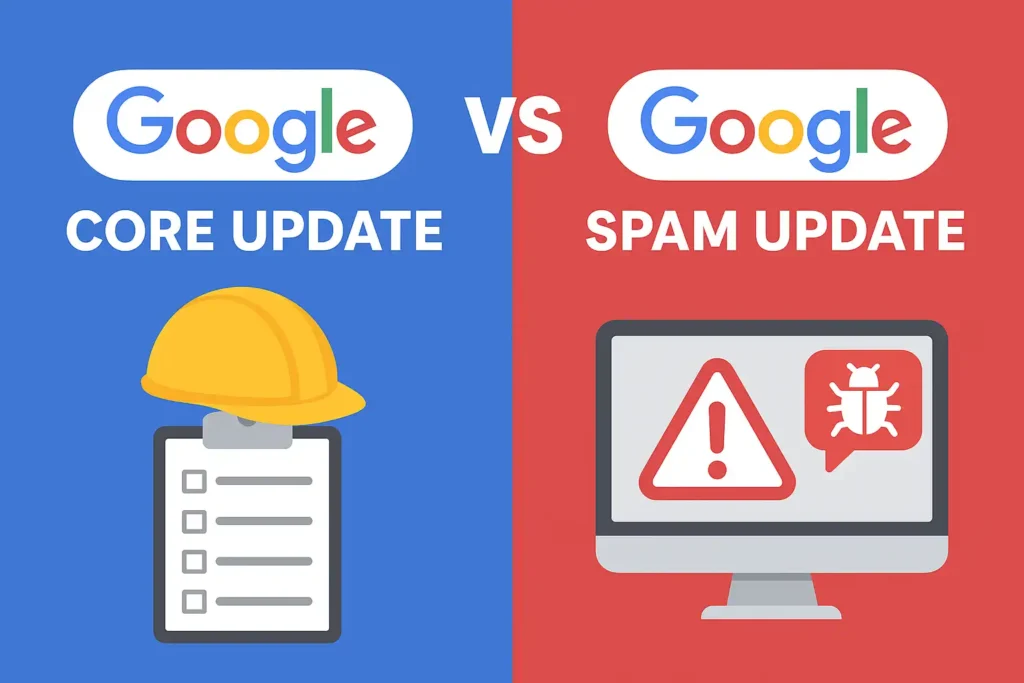
Understanding the Key Differences between Google Core Update vs Google Spam Update.
By Francis Waithaka, CEO & Lead Trainer at Digital 4 Africa
Why Google Core Updates and Spam Updates Are Not the Same
As the lead of a digital marketing agency, I’ve sat across the table from countless business owners. The look I see most often is a specific kind of panic, the kind that comes from watching your website’s traffic —the very lifeblood of your online presence —fall off a cliff overnight.
The first question is always the same: “What did we do wrong? Were we penalized?”
This is the most critical diagnostic moment in the entire SEO process. The answer requires us to understand that not all Google updates are punishments. Some are simply the rules of the game changing.
To clarify this, let’s use an analogy. Think of Google as the County Government that sets the standards for all building construction in its jurisdiction.
- A Google Core Update is the County Government updating the building code.
- A Google Spam Update is the County Government sending an inspector to condemn a building that used faulty materials and violated existing safety laws.
One is a recalibration of standards; the other is an enforcement of rules. Understanding this difference is crucial to developing a recovery plan that actually works.
A Review of the 2025 Update Timeline
To ground this discussion, let’s examine the confirmed updates that Google has rolled out this year. At our agency, we don’t guess; we track official announcements. According to Google’s own Search Status Dashboard and reporting from reputable industry journals like Search Engine Land, the 2025 landscape has been shaped by these key events:
- The March 2025 Core Update (March 13-March 27, 2025): This was a comprehensive core update. The rollout was completed over 14 days, causing significant ranking volatility as Google’s systems re-evaluated site quality across the web (Google, 2025).
- The June 2025 Core Update (June 30 – July 17, 2025): This was another significant core update, which took nearly 17 days to complete. Again, this was a wide-ranging update designed to refine how Google’s core systems assess content (Google, 2025).
- The August 2025 Spam Update (August 26 – September 22, 2025): This was a targeted spam update that took 27 days to roll out (Schwartz, 2025). Unlike the Core updates, its goal was to find and neutralize sites violating Google’s established Spam Policies.
The timing of your traffic drop is the first clue. If it correlates perfectly with one of these windows, you know where to start your investigation.
How These Updates Actually Affect Your Website
Let’s return to our County Government analogy to see what these updates feel like for a site owner.
The Core Update
Imagine you’re a contractor who built a high-quality house in 2023. You followed the building code perfectly. Your client was happy, and the house was valued highly.
In March 2025, the County Government passes a new “Green Energy & Safety Code.” This code now requires all new and existing property valuations to factor in solar panel readiness, higher-grade insulation, and reinforced foundations for earthquake safety.
You didn’t do anything wrong. Your 2023 house is still a good house.
However, when it’s re-appraised, its value drops. Why? Because a new house built down the street included these new features. Relative to the new standard, your perfectly good house is now considered less valuable and less helpful to the modern homeowner. You haven’t been fined. You haven’t been condemned. You’ve simply been re-evaluated against a higher, more modern standard.
This is exactly how a Google Core Update works.
- The Impact: You see a “suppression” of your rankings. You may fall from position #2 to position #9, or from page 1 to page 2. Your site isn’t gone, it just feels like it’s lost its authority.
- The Cause: Google’s algorithm has refined its understanding of what “helpful” and “high-quality” mean. It has re-evaluated your site and found that other websites now provide a better, more comprehensive, or more trustworthy answer to the user’s query.
County Inspector The Spam Update
Now, let’s take a different scenario. An inspector arrives at a building site and discovers that the contractor is actively committing fraud.
- They are using counterfeit wood painted to look like high-grade lumber (cloaking or hidden text).
- They built a beautiful, fake facade on the front of the building, but the back is just plywood and tape (doorway pages).
- They paid off a hundred random people to stand outside and tell passersby how great the building is (link schemes).
This contractor hasn’t only failed to meet the new code, but has also intentionally and deceptively violated the existing safety rules.
The inspector doesn’t re-evaluate the building; he slaps a condemnation notice on the door, fines the contractor, and revokes their license. The building is, for all intents and purposes, removed from the public register.
This is a Google Spam Update.
- The Impact: This is not a gentle drop. This is a catastrophic, overnight disappearance. Your site may be completely de-indexed (gone from Google) or receive a “Manual Action” in Google Search Console—a literal penalty notice.
- The Cause: Your site was caught engaging in deceptive practices explicitly forbidden by Google’s Spam Policies. This isn’t about quality; it’s about cheating.
The Recovery Playbook – What to Do When You’re Hit
Panic is not a strategy. A measured, intelligent response is. Your recovery plan depends entirely on which update hit you.
Checklist: If Hit by a Google Core Update (The “New Building Code”)
Your goal is not to “fix” a penalty. Your goal is to upgrade your entire house to meet the new code.
- Breathe. Wait. Do not make drastic changes while the update is still being rolled out. Wait until the volatility has ended (1-2 weeks after the “completed” date).
- Confirm It’s Not a Penalty. Go to your Google Search Console. Under “Security & Manual Actions,” check for a “Manual Action.” If it says “No issues detected,” you are not penalized. This is a quality re-evaluation.
- Read Google’s Questions. Google has explicitly told us what to do. Read their official blog post, “What site owners should know about core updates.” It’s a list of questions to ask yourself about your content, quality, and presentation (Google Search Central, 2024).
- Analyze the Winners. This is your most important action item. Search for your most valuable keywords that dropped. Take a look at the new pages that have replaced you in the top 3 spots. What do they have that you don’t?
- Do they demonstrate more first-hand Experience (the new “E” in E-E-A-T)?
- Are their authors more clearly defined Experts?
- Is their content more comprehensive, with original data, images, or videos? .
- Conduct an E-E-A-T Audit. Start with your “About” page, author bios, and contact information. Are you a faceless entity? Or are you a trustworthy brand with real, experienced experts?
- Refresh, Don’t Just Rewrite. Identify your pages that lost the most traffic. Your job is to make them 10x better. This means adding new information, new data, expert quotes, and first-hand insights.
- Be Patient. This is the hardest part. You will not recover next week. You must improve your site’s overall quality and then wait for Google to re-evaluate you. This often means you won’t see a full recovery until the next broad core update, which could be months away.
Checklist If Hit by a Google Spam Update
Your goal is to find the violation, remove it completely, and prove to the “inspector” that you are back in compliance.
- Check for a Manual Action. This is your first and most urgent stop. Go to Google Search Console. If you have a Manual Action, Google will tell you what you did wrong (e.g., “Unnatural links,” “Thin content,” “Cloaking”). This is your instruction manual.
- If No Manual Action, It Was Algorithmic. The August 2025 Spam Update was algorithmic, meaning Google’s AI caught you. You won’t get a note, so you have to be the inspector. Be brutally honest with yourself.
- Audit Your Links. Did you buy a link package? Are you part of a private blog network (PBN)? Are you swapping links with unrelated sites? You must identify these toxic links and use Google’s Disavow Tool to tell Google to ignore them.
- Audit Your Content. Did you use an AI tool to generate 500 low-quality articles? Are you “keyword stuffing”? Are you “scraping” content from other sites? The answer is simple: delete it. You cannot “fix” spam. You must remove it.
- File a Reconsideration Request. Only if you had a Manual Action. After you have cleaned your site (and only after), you file this request. Be humble, specific, and exhaustive.
- Good Request: “We found 1,500 spammy links we purchased. We have disavowed them all. Here is the spreadsheet. We have also deleted 300 thin, auto-generated pages. Here is the list. We violated the policies and have now fixed it.”
- Bad Request: “We don’t know what we did wrong, but we’re sorry! Please re-index us.”
- Wait. Recovery from an algorithmic spam hit can happen as Google re-crawls your clean site. Recovery from a manual action will happen once your reconsideration request is approved.
The Role of E-E-A-T: Your Brand’s Foundation
In all of this, one concept has become the single most important framework in modern SEO: E-E-A-T.
This stands for Experience, Expertise, Authoritativeness, and Trustworthiness.
E-E-A-T is not a single ranking factor. It is the framework Google’s human quality raters use to evaluate content, and those ratings are used to train the core ranking algorithms (Search Engine Journal, 2023). It is the “master building code.”
- Experience: The newest, and arguably most important, signal. Does the author have first-hand, real-world experience with the topic? A review of a product by someone who has clearly used it (with original photos) will beat a review that just rephrases the manufacturer’s specs.
- Expertise: Is the author a subject matter expert? You want medical advice from a doctor, not a random blogger. Your site must demonstrate its authors’ credentials.
- Authoritativeness: Is your brand or author a recognized authority in the field? When other experts in your industry link to you and cite you, that builds authority.
- Trustworthiness: This is the foundation. Is your site secure (HTTPS)? Is your “About Us” and “Contact” information easy to find? Are your sources cited? Do you show the real people behind your brand?
Core Updates are almost always a re-evaluation of E-E-A-T. Spam Updates are often about catching sites that are faking E-E-A-T (e.g., creating fake author bios or buying links to fake authority).
As an agency, our focus has shifted. We no longer just build links or optimize keywords. We build entities. We work to make your brand the most experienced, expert, authoritative, and trustworthy resource in its field. When you do that, you stop fearing Core Updates. You start benefiting from them, because you’ve already built your house to the code of tomorrow.
Francis Waithaka is the CEO and Lead Trainer at Digital 4 Africa, with over 22 years of experience in information technology and digital marketing. He has worked with over 100 companies across East Africa and is a certified digital marketer by Google, Facebook, Twitter, and LinkedIn. Connect with him on Twitter @waithash.
Sources and Citations
- Google. (2025). Google Search Status Dashboard: Ranking. Retrieved November 4, 2025, from https://status.search.google.com/summary
- Google Search Central. (2024). What site owners should know about Google’s core updates. Retrieved from https://developers.google.com/search/blog/2024/03/core-update-helpful-content
- Schwartz, B. (2025, September 22). Google’s Wild August 2025 Spam Update Finished Rolling Out. Search Engine Roundtable.
- Search Engine Journal. (2023). E-E-A-T: How To Demonstrate Experience, Expertise, Authoritativeness & Trust.